


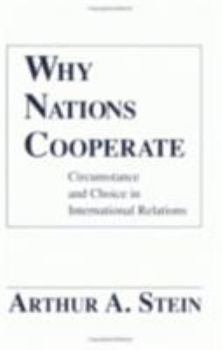
Why Nations Cooperate


Select Format
Select Condition 
Book Overview
No Synopsis Available.
Format:Paperback
Language:English
ISBN:0801497817
ISBN13:9780801497810
Release Date:January 1993
Publisher:Cornell University Press
Length:232 Pages
Weight:0.85 lbs.
Dimensions:0.7" x 6.1" x 9.0"
Age Range:18 years and up
Grade Range:Postsecondary and higher
Customer Reviews
2 ratings
Nice theoretical framework
Published by Thriftbooks.com User , 16 years ago
I would definitely recommend the book for students and international relations theory afficionados. It does a very nice job of reconciling aspects of realism with those of liberalism. Game theory is used in very simple form, so it's readable even for the uninitiated. It's definitely not for those who hate theory. This is definitely theoretical. That said, it reads very well, unlike most theory books, which tend to be dense and dry. Some thought actually went into the writing style of this book, which makes for a pleasant experience.
Good introduction to theoretical debates in international relations today, if a bit dated
Published by Thriftbooks.com User , 18 years ago
This book is based on a simple idea: because "Realist" theories of international relations emphasize conflict, while "Liberal" theories emphasize international cooperation, one can reasonably combine insights from both approaches by using simple games of conflict *and* cooperation - - such as the famous Prisoners' Dilemma. Stein then goes further and argues that many other problems of international relations can be examined with other simple games, such as Chicken or Coordination (Battle of the Sexes). He makes the case successfully, emphasizing the theoretical side of international relations while including some real-world problems throughout the book. The book has become somewhat dated. Scholars of international relations tend not to emphasize Realist-Liberal debates anymore, preferring a rational-constructivist debate; both Realists and Liberals find themselves among the rationalists. The two-by-two games in this book are also very dated, since most game-theoretic models are much more complicated today. Being out of step with current debates doesn't really hurt Stein's book if you're looking for an introduction to theories of international relations - - read this as background to the debates of the last fifteen years. Stein identifies with parts of each approach, and with game-theoretic methods. However, he likes taking the role of a friendly critic, making his presentation the material balanced. If you're looking for hypotheses, data collection, and statistical tests, however, you'll be disappointed in this book. It's very much a work of international relations theory, explained in a way that should make sense to intelligent undergraduates, and doesn't worry too much about evidence. I am inclined to say this isn't a defect - - it's a feature.
Copyright © 2026 Thriftbooks.com Terms of Use
| Privacy Policy | Do Not
Sell/Share My Personal Information | Cookie Policy | Cookie Preferences | Accessibility Statement
ThriftBooks® and the ThriftBooks® logo are registered trademarks of Thrift Books Global, LLC
ThriftBooks® and the ThriftBooks® logo are registered trademarks of Thrift Books Global, LLC
