


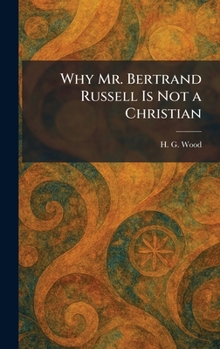
Why Mr. Bertrand Russell Is Not a Christian

"Why Mr. Bertrand Russell Is Not a Christian" is a rigorous and thoughtful response to the philosophical challenges posed by one of the 20th century's most famous skeptics. In this work, H. G. Wood engages directly with the arguments presented by Bertrand Russell, particularly those concerning the validity of Christian belief and the nature of religious evidence. Wood, a distinguished theologian, provides a point-by-point analysis of Russell's logic, questioning the premises of his secular framework and offering a spirited defense of the Christian faith.
The book delves into core issues of morality, the historical foundation of the Gospels, and the intellectual coherence of theism. By addressing the skepticism of his contemporary, Wood provides readers with a deep exploration of the tension between rationalist critique and religious conviction. This work remains a valuable historical document in the field of Christian apologetics, reflecting the vital intellectual debates of the interwar period. It is an essential resource for scholars of philosophy, theology, and anyone interested in the enduring dialogue between faith and reason.
This work has been selected by scholars as being culturally important, and is part of the knowledge base of civilization as we know it. This work was reproduced from the original artifact, and remains as true to the original work as possible. Therefore, you may see the original copyright references, library stamps (as most of these works have been housed in our most important libraries around the world), and other notations in the work.
This work is in the public domain in the United States of America, and possibly other nations. Within the United States, you may freely copy and distribute this work, as no entity (individual or corporate) has a copyright on the body of the work.
As a reproduction of a historical artifact, this work may contain missing or blurred pages, poor pictures, errant marks, etc. Scholars believe, and we concur, that this work is important enough to be preserved, reproduced, and made generally available to the public. We appreciate your support of the preservation process, and thank you for being an important part of keeping this knowledge alive and relevant.
Customer Reviews
ThriftBooks ® and the ThriftBooks ® logo are registered trademarks of Thrift Books Global, LLC
