


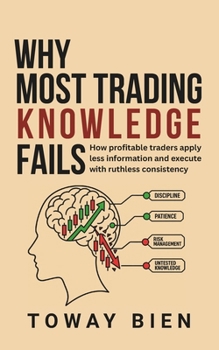
Why Most Trading Knowledge Fails: How profitable traders apply less information and execute with ruthless consistency

What if the knowledge you keep adding to your trading is making it harder to trade well?
For many traders, learning never stops. New strategies, indicators, market opinions, and endless analysis create the feeling of preparation while quietly producing hesitation, conflicting signals, overthinking, and inconsistent execution. The problem is not always that you know too little. Sometimes, you know too much-and still struggle to act on what already works.
Why Most Trading Knowledge Fails presents a different approach to trading performance: less information, fewer decisions, clearer rules, deeper repetition, and disciplined execution. Inside, you will learn how to:
- Cut through information overload and protect decision quality.
- Narrow your conditions so clarity replaces hesitation.
- Trade more selectively while preserving attention, capital, and composure.
- Build simple, non-negotiable rules that hold under pressure.
- Separate emotion and short-term outcomes from disciplined execution.
- Develop habits, process loyalty, and identity-based discipline that make consistency more natural.
This is not a book about secret indicators, perfect systems, or predicting every market move. It is about what happens after the analysis is finished-when uncertainty remains, emotions rise, opportunities tempt you, and your rules are tested.
The goal is not to become a trader who knows everything. It is to become a trader who knows what matters, trusts the process, waits when waiting is required, and acts decisively when conditions align.
Stop adding noise to a process that needs clarity. Read Why Most Trading Knowledge Fails and learn to turn what you already know into disciplined execution.
Customer Reviews
ThriftBooks ® and the ThriftBooks ® logo are registered trademarks of Thrift Books Global, LLC
