


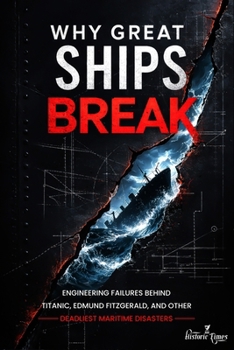
Why Great Ships Break: Engineering Failures Behind Titanic, Edmund Fitzgerald, and Other Deadliest Maritime Disasters
No Customer Reviews

Every generation builds machines that appear unstoppable. Steel giants cross oceans under the flags of powerful nations. Submarines descend into depths where pressure crushes ordinary metal like paper. Rockets rise through the sky on pillars of fire, carrying human ambition beyond the atmosphere itself. And yet history tells a different story. Again and again, the most advanced machines ever built have failed in ways no one expected. On a freezing April night in 1912, the Titanic sinking shocked the world and forced engineers to confront uncomfortable questions about steel, rivets, and the limits of watertight design. Decades later, in the violent waters of the Atlantic, the mighty German battleship Bismarck fought one of the most famous naval pursuits in history, only to be crippled not by armor penetration but by the loss of control itself. In 1963 the nuclear submarine USS Thresher disappeared during a routine deep-diving test, revealing how fragile the boundary between engineering ambition and ocean pressure could be. Even beyond the sea, the same pattern emerged. In 1986 the Space Shuttle Challenger engineering failure demonstrated how a single material property hidden inside a rubber seal could destroy one of the most sophisticated machines ever built. These events are often remembered as tragedies. But to engineers they are also investigations. Beneath the drama of shipwrecks and explosions lies a deeper pattern. Ship structural failure, progressive flooding, ship stability collapse, and watertight compartment limits are not random disasters. They are engineering problems unfolding step by step as forces, materials, and decisions collide. This book reveals those hidden mechanics. Through detailed shipwreck engineering analysis and historical research, it uncovers how design assumptions, material behavior, and operational choices combined to produce some of the most devastating maritime engineering disasters ever recorded. From the cold Atlantic where the Titanic foundered, to the desperate hunt for Bismarck, to the depths where submarines face the terrifying physics of submarine implosion, the investigation follows the trail of failure across oceans and decades. The story also reaches the inland seas of North America. The loss of the Edmund Fitzgerald on Lake Superior, during the legendary Gales of November, remains one of the most haunting shipwrecks in maritime history. There, as in the open ocean, storms, structure, and stability combined in ways sailors and engineers are still trying to understand. What connects these disasters is not simply tragedy. It is a pattern. Ships rarely fail because of a single dramatic moment. They fail because small weaknesses meet powerful forces, and because the margin between safety and catastrophe is often thinner than anyone realizes. In the end the ocean does not care about reputation, tonnage, or technological confidence. It measures every vessel according to the same unforgiving laws of physics. And once you begin to see those laws at work, the history of shipwrecks looks very different. You begin to realize that the next great ship is already sailing and the forces that could break it are already waiting.
Format:Paperback
Language:English
ISBN:B0GS1NGZ6G
ISBN13:9798251392791
Release Date:March 2026
Publisher:Independently Published
Length:394 Pages
Weight:1.16 lbs.
Dimensions:0.8" x 6.0" x 9.0"
Related Subjects
TransportationCustomer Reviews
0 rating
Copyright © 2026 Thriftbooks.com
Terms of Use | Privacy Policy | Do Not Sell/Share My Personal Information | Cookie Policy | Cookie Preferences | Accessibility Statement
ThriftBooks ® and the ThriftBooks ® logo are registered trademarks of Thrift Books Global, LLC
ThriftBooks ® and the ThriftBooks ® logo are registered trademarks of Thrift Books Global, LLC
