


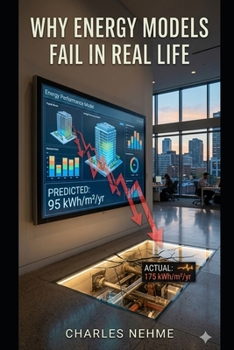
Why Energy Models Fail in Real Life

Energy modelling has become a cornerstone of modern building design. It promises clarity in decision-making, predictability in performance, and confidence in investment. In theory, it is one of the most powerful tools in building engineering. In practice, however, the gap between what is predicted and what is actually achieved remains stubbornly persistent.
This book was written to address a reality that many engineers, consultants, and developers quietly acknowledge but rarely document: energy models often fail to reflect real-life building performance.
Not because the tools are fundamentally wrong, but because the world they attempt to simulate is far more complex, unpredictable, and human than any model can fully capture.
Assumptions replace uncertainty. Standards replace context. Simulations replace reality. And somewhere between design intent and operational life, the building evolves into something the model never truly represented.
This is not a critique of energy modelling itself-it is an examination of its limits. More importantly, it is an exploration of how and why those limits appear, and what can be done to bridge the divide between prediction and performance.
The aim of this book is not to discard modelling practices, but to challenge overconfidence in their outputs and encourage a more grounded, data-informed, and operationally aware approach to building energy analysis.
Customer Reviews
ThriftBooks ® and the ThriftBooks ® logo are registered trademarks of Thrift Books Global, LLC
