


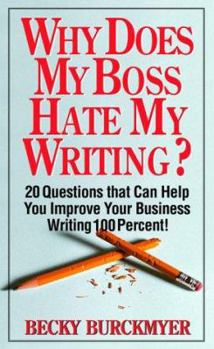
Why Does My Boss Hate My Writing?: 20 Questions That Can Help You Improve Your Business Writing 100 Percent!

A recent survey of Fortune 500 executives revealed that 80% are dissatisfied with the quality of their employees'' written communications. This text aims to give readers a practical advice on how to... This description may be from another edition of this product.
Format:Paperback
Language:English
ISBN:1580620574
ISBN13:9781580620574
Release Date:January 1998
Publisher:Adams Media Corp
Length:228 Pages
Weight:0.45 lbs.
Dimensions:7.5" x 0.8" x 4.3"
Customer Reviews
5 ratings
The Personality of the Author Shines Through
Published by Thriftbooks.com User , 25 years ago
What's amazing and valuable about this extremely entertaining book, which comes disguised as a manual for the challenged writer, is the humane, intelligent, sensible and charming persona behind every sentence. (Incidentally, it's probably true that a challenged writer is anyone who is making a decent effort.) There are life lessons in here -- about the value of being truthful and clear and kind. For example, Burckmyer tells you how to avoid being unintentionally mean or patronizing. E.g.: ``As you are surely aware, this seminar is available to corporate clients only." Presidents Clinton and Nixon might well have benefitted from a section in the same chapter that begins: ``When you must apologize, do it up front and in full." Burckmyer is not at all the rigid English teacher. For example, she shows how the passive voice may be useful in some cases, to protect someone. As in: `` `A mistake was made in Customer Service.' (It was Betsy's first day on the job: let's give her another chance. If this customer gets her name, she's toast.)" She's kind to readers (as well as to Betsy), gently leading us out of the traps we all get stuck in trying to undo a split infinitive, or rewrite a sentence that ends with a preposition or correct a dangling participle. She shows us in a nice way how to avoid the embarassment of being caught mixing metaphors. Why is this sensible advice only for business writers anyway? Poets need to be clear, historians need to be concise. Mystery writers need to avoid dangling participles. There are newspaper columnists and novelists out there who could benefit from everything in here. The lifesaver in the book, useful for anyone writing anything, is Appendix A, ``Getting Started and Following Through on a Writing Project." This isn't mushy believe-in-your-dream kind of stuff. One good practical piece of advice: ``Don't stop when you're in trouble." Burckmyer is pretty much, via print, the perfect teacher. Firm but gentle.
Strunk & White for the business world in the 00s and beyond!
Published by Thriftbooks.com User , 26 years ago
At last, a style manual with style!Each chapter in this little gem of a book asks and answers a question on writing, everything from "Have I Written for my Audience?" to "Have I Sweated the Small Stuff?" Although geared to the workplace, the author's common sense approach to grammar and writing would work in any setting. Imagine the rules of grammar written in an informal style, very clearly, and often with wit (e.g., the "breath comma" and the "death comma")! Each chapter is filled with very good examples and with practical solutions to common writing problems. Each chapter also ends with helpful bulleted notes to summarize key points. A very practical guide to help readers improve their writing, but also kind of fun to read!
The most amusing and useful style manual ever.
Published by Thriftbooks.com User , 26 years ago
Ms. Burckmyer has obviously mastered the art of writing herself, and can make her readers laugh while she also teaches them. This is a gem, and its scope is far beyond the world of business writing; anyone who seeks to communicate effectively in print will gain from reading it. And chuckle besides!
A practical and effective primer that is fun to read!
Published by Thriftbooks.com User , 26 years ago
If only Ms. Burckmyer had written this gem 20 years ago! I am a recently retired business executive who had to resort to my own improvised methods of teaching the rules of English construction and effective writing to a generation of bright young managers whose good ideas were masked far too often by disorganized and poorly executed written work.Why Does My Boss Hate My Writing? is a handy little book that can be readily absorbed --and actually enjoyed-- by even the most reluctant or defensive of those in need of remedial instruction. It tackles and teaches the basics of good writing in easy-to-read chapters that illustrate, often with engaging humor, the practical consequences of inattention to the rules of effective writing.Ms. Burckmyer accomplishes much more than providing the reader with an enumeration of the basic lessons of grammar and syntax, she addresses the subtleties of tone and style that soothe the concerns of disgruntled customers, win negotiations with business adversaries, and convince the skeptics within our organizations of the wisdom of our thinking.I highly recommend this succinct and well written primer. It should be required reading for every management trainee, newly minted M.B.A., and the legions of junior consultants, lawyers, and accountants who aspire to be business advisors. I also recommend this book for the seasoned executive; it contains some helpful reminders that may refrest your own writing style and make you a more effective critic of your company's communications.
A sparkling new look at the basic rules of expression
Published by Thriftbooks.com User , 27 years ago
In this new book on writing, Becky Burckmyer aims directly at helping people in the business world improve their writing skills. But the book will be useful for a far wider audience. In a funny, erudite style, Burckmyer combines the powerful simplicity of Strunk and White's "The Elements of Style" with the sophisticated and durable wisdom of "The Careful Writer" by Theodore Bernstein. She has taken the old basic rules--rules so often mangled in today's business world--and showcased them in terms of today's linguistic situations. One of the strongest messages here is that when it comes to written communications, it isn't good enough to get things 98 or 99 per cent right; it's the small, glaring mistake that can become the writer's self-portrait. Burckmyer's entertaining look at language will be useful not only as a handbook within the workplace but should take it's place on the shelf of anyone who wants to be an effective writer.
Copyright © 2026 Thriftbooks.com Terms of Use
| Privacy Policy | Do Not
Sell/Share My Personal Information | Cookie Policy | Cookie Preferences | Accessibility Statement
ThriftBooks® and the ThriftBooks® logo are registered trademarks of Thrift Books Global, LLC
ThriftBooks® and the ThriftBooks® logo are registered trademarks of Thrift Books Global, LLC
