


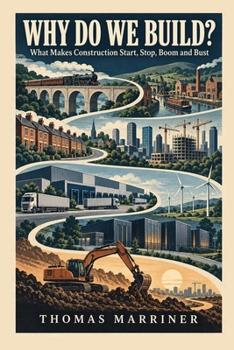
Why Do We Build?: What Makes Construction Start, Stop, Boom and Bust

Why are cranes everywhere one year - and nowhere the next?
Why can a country desperately need more homes, better infrastructure, new schools, energy networks and industrial capacity, yet still build too little? Why do some projects survive recessions while others disappear after planning permission has been granted? Why can interest rates fall without construction immediately recovering? And why can a boom leave behind both valuable infrastructure and financial wreckage?
Why Do We Build? follows one deceptively simple question all the way back from the construction site: what had to happen before somebody finally decided to build?
Thomas Marriner works upstream from the visible site to uncover the chain of expectations, money, policy and decisions that turns an idea into physical construction. Need must become effective demand. A project has to survive viability. Finance must be available. Permission has to be secured. Someone has to commit. The construction industry then has to possess the people, materials, factories, specialist skills and risk-bearing capacity to deliver it.
Only then does the crane appear.
Using episodes ranging from Railway Mania and post-war housing to the 1970s property boom, the global financial crisis, regulated water investment, e-commerce warehouses, COVID-19 and the emerging demand for AI and data-centre infrastructure, the book explains why construction starts, stops, booms and busts - and why different parts of the industry can move in completely different directions at the same time.
You will learn why:
- need does not automatically become construction;
- a huge project pipeline can coexist with an empty order book;
- finance acts as permission, not merely as a cost;
- small changes in rents, yields, interest rates or construction costs can push a project over a "viability cliff";
- planning approval, funding announcements and even tenders are not the same as committed work;
- housing, infrastructure, energy, offices, logistics and public construction run on different economic clocks;
- today's busy construction sites may reflect decisions made years ago;
- technology can create entirely new building markets while stranding old ones;
- governments can create, accelerate, delay or close construction markets without laying a single brick;
- booms and busts change the industry's capacity long after the original economic shock has passed; and
- construction and property can eventually feed back into credit, investment and the wider economy.
This is a book for far more than contractors.
It is for anyone working in construction, property, development, infrastructure, finance, investment, planning, public policy or government. It is for business leaders trying to understand capital investment and economic cycles. It is for students and professionals who want to connect economics with the physical world. And it is for curious readers who have ever looked at a new housing estate, warehouse, railway, data centre or abandoned project and wondered:
Why here? Why now? And why did this one happen when another did not?
Why Do We Build? is not a forecasting manual and it does not pretend that one economic indicator can tell us what happens next. Instead, it gives the reader a way to read the signals properly: to distinguish need from demand, pipelines from orders, announcements from commitments, temporary shocks from structural change, and one construction cycle from another.
Because the construction site is not the beginning of the story.
It is the end of a long chain of decisions about the future.
Customer Reviews
ThriftBooks ® and the ThriftBooks ® logo are registered trademarks of Thrift Books Global, LLC
