


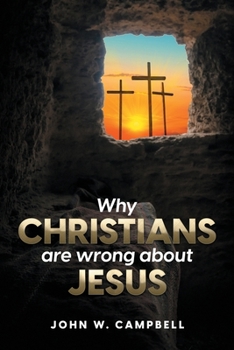
Why Christians are wrong about Jesus

Most Christians have never truly examined what they believe about Jesus. Now a trial lawyer, someone whose career depends on separating fact from assumption, has turned the full weight of legal and historical scrutiny on Christianity's most sacred claims. What he found may change everything you thought you knew.
Billions follow Jesus. But how many have asked whether the Jesus they follow resembles the man who actually lived? In this follow-up to Cross-Examined: Putting Christianity on Trial, Campbell applies the same standards historians use to evaluate ancient literature to the Bible's most foundational claims, giving no special privilege to scripture simply because Christianity is widely practiced. The real Jesus, what he believed, what he taught, and what he would have made of modern Christianity, has been buried under nearly two thousand years of theology. Campbell goes digging.
Campbell begins with a question Christians rarely ask: why did the Jewish people, who wrote the prophecies, reject Jesus as their Messiah? Christians point to Old Testament scriptures as proof, but Campbell examines each one and shows why, under honest historical scrutiny, none of them hold up. If Jesus was not the Messiah, the entire foundation of Christianity shifts. Campbell makes the case that the evidence, examined without bias, points firmly in that direction.
Paul never met the living Jesus, never heard him teach, and never witnessed his ministry. Yet it is Paul's version of Jesus, not the original, that became the foundation of modern Christianity. The real Jesus was a first century Jewish teacher with specific beliefs, a specific mission, and a worldview shaped entirely by Second Temple Judaism. Campbell shows how that Jesus was gradually overwritten by a Christ of faith that the historical Jesus would not have recognized. Paul and the original apostles who actually knew Jesus were in open conflict. Campbell reveals what that conflict was about and why Paul's version won, at the expense of nearly everything the real Jesus stood for.
The resurrection is the cornerstone of Christian theology. Without it, as Paul himself admitted, the faith collapses. Many Christians privately wrestle with this claim, and Campbell gives voice to those doubts, walking through the evidence carefully and honestly. He explores what the historical record actually shows about the resurrection accounts, why the empty tomb stories developed the way they did, and why bereavement hallucinations and legend offer far more plausible explanations than a literal rising from the dead. Examining the evidence with the same rigor a lawyer would bring to a courtroom, Campbell finds it does not meet the burden of proof.
John W. Campbell has spent his career in courtrooms where evidence is everything and assumptions are liabilities. Author of Cross-Examined: Putting Christianity on Trial, he returns with a sharper, more focused investigation that zeros in exclusively on Jesus and draws on the most current historical research available. Campbell does not approach this subject as an atheist with an agenda or a believer with a bias. He approaches it as a historian and a lawyer, committed only to following the evidence wherever it leads.
If you have ever wondered whether the Jesus of modern Christianity matches the Jesus of history. this book was written for you. It is for anyone with the courage to ask the questions most Christians are never encouraged to ask. The evidence is in. The only question is whether you are willing to look at it.
Customer Reviews
ThriftBooks ® and the ThriftBooks ® logo are registered trademarks of Thrift Books Global, LLC
