


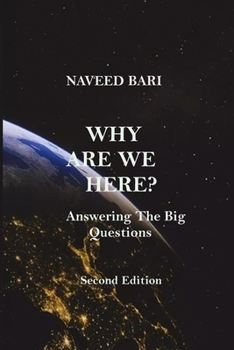
Why Are We Here?: Answering The Big Questions
No Customer Reviews

Why Are We Here? This profound and timeless question echoes through the corridors of human existence, transcending gender, race, and creed. It is a question that every human being, at some point in their life, confronts. This book ventures to propose common sense answers that resonate with the majority, irrespective of their religious or philosophical beliefs. Though religious texts are employed to elucidate certain points, the discourse remains inclusive, ensuring that even those without religious inclinations can find agreement with the arguments presented.
The central thesis of this book is both bold and enlightening: our creation is an ongoing process, and our presence on this earth is an integral part of that creative journey. To support this idea, a rich tapestry of philosophical, scientific, and religious arguments is woven, inviting the reader to analyze the issue from multiple viewpoints. As the reader delves deeper, they will learn to examine the various stances on "God"-whether atheistic, agnostic, or theistic-from a rational perspective. In doing so, they might discover that the apparent differences between these positions often stem from the rigid definitions of concepts such as "God," "Heaven," "Hell," "Predestination," and "Satan." Through the lens of reason, these concepts can be reinterpreted to accommodate a wide spectrum of beliefs. From the Muslim perspective, this book holds particular significance as it offers a fresh illumination of the Qur'an's teachings. In today's world, the concept of "religion"-and Islam in particular-is frequently perceived as being synonymous with rigid rules, legalistic governance, intolerance, and even terrorism. This perception has led both Muslims and non-Muslims to view Islam predominantly as a legalistic religion focused on political dominance. However, this narrow vision obscures the deeper, more philosophical teachings of the Qur'an, which address the fundamental questions of life.This book aims to unveil this often-hidden dimension of Islam. It encourages readers to see the Qur'an not merely as a manual of ritualistic worship and political directives but as a profound guide that addresses the most essential questions: Why do we exist here? Why do we suffer? What is true success? In doing so, it seeks to shift the focus from the contentious and often violent aspects of religious expression to a more spiritual and rational understanding of Islam, one that appeals to reason and common sense. In a world fraught with religious conflict and intolerance, the need for such a shift is urgent. By drawing upon the Qur'an, alongside other revered scriptures like the Bible and the Buddhist Dhammapada, this book aspires to unite people in their quest for answers to life's fundamental questions. It is a call to transcend the barriers of rigid definitions and divisive ideologies, fostering a shared journey towards understanding the essence of our existence.
Format:Paperback
Language:English
ISBN:B0DCK6W7TL
ISBN13:9798335348539
Release Date:August 2024
Publisher:Independently Published
Length:172 Pages
Weight:0.52 lbs.
Dimensions:0.4" x 6.0" x 9.0"
Customer Reviews
0 rating
Copyright © 2026 Thriftbooks.com
Terms of Use | Privacy Policy | Do Not Sell/Share My Personal Information | Cookie Notice | Cookie Preferences | Accessibility Statement
ThriftBooks ® and the ThriftBooks ® logo are registered trademarks of Thrift Books Global, LLC
ThriftBooks ® and the ThriftBooks ® logo are registered trademarks of Thrift Books Global, LLC
