


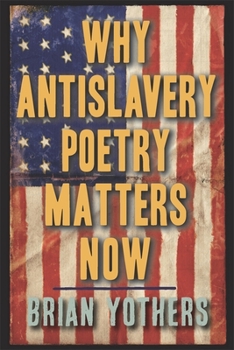
Why Antislavery Poetry Matters Now
No Customer Reviews

This book is a history of the nineteenth-century poetry of slavery and freedom framed as an argument about the nature of poetry itself: why we write it, why we read it, how it interacts with history. The poetry of the transatlantic abolitionist movement represented a powerful alliance across racial and religious boundaries; today it challenges the demarcation in literary studies between cultural and aesthetic approaches. Now is a particularly apt moment for its study. This book is a history of the nineteenth-century poetry of slavery and freedom framed as an argument about the nature of poetry itself: why we write it, why we read it, how it interacts with history. Poetry that speaks to a broad cross-section of society with moral authority, intellectual ambition, and artistic complexity mattered in the fraught years of the mid nineteenth century; Brian Yothers argues that it can and must matter today.
Yothers examines antislavery poetry in light of recent work by historians, scholars in literary, cultural, and rhetorical studies, African-Americanists, scholars of race and gender studies, and theorists of poetics. That interdisciplinary sweep is mirrored by the range of writers he considers: from the canonical - Whitman, Barrett Browning, Beecher Stowe, DuBois, Melville - to those whose influence has faded - Longfellow, Lydia Huntley Sigourney, John Pierpont, John Greenleaf Whittier, James Russell Lowell - to African American writers whose work has been recovered in recent decades - James M. Whitfield, William Wells Brown, George Moses Horton, Frances E. W. Harper.
Yothers examines antislavery poetry in light of recent work by historians, scholars in literary, cultural, and rhetorical studies, African-Americanists, scholars of race and gender studies, and theorists of poetics. That interdisciplinary sweep is mirrored by the range of writers he considers: from the canonical - Whitman, Barrett Browning, Beecher Stowe, DuBois, Melville - to those whose influence has faded - Longfellow, Lydia Huntley Sigourney, John Pierpont, John Greenleaf Whittier, James Russell Lowell - to African American writers whose work has been recovered in recent decades - James M. Whitfield, William Wells Brown, George Moses Horton, Frances E. W. Harper.
Format:Hardcover
Language:English
ISBN:1640140697
ISBN13:9781640140691
Release Date:June 2023
Publisher:Camden House (NY)
Length:308 Pages
Weight:1.29 lbs.
Dimensions:0.8" x 6.0" x 9.0"
Customer Reviews
0 rating
Copyright © 2026 Thriftbooks.com Terms of Use
| Privacy Policy | Do Not
Sell/Share My Personal Information | Cookie Policy | Cookie Preferences | Accessibility Statement
ThriftBooks® and the ThriftBooks® logo are registered trademarks of Thrift Books Global, LLC
ThriftBooks® and the ThriftBooks® logo are registered trademarks of Thrift Books Global, LLC
