


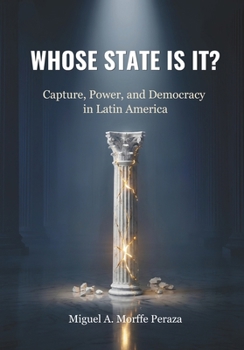
Whose State Is It?: State Capture, Power, and Democracy in Latin America

Who really decides what happens inside a state?
Behind a law that is passed, a public contract that is awarded, or an appointment that is made, there are often interests seeking to shape the outcome. Some operate legally through lobbying, campaign financing, or privileged access. Others rely on criminal networks, coercion, or institutional infiltration. Still others act from within the state itself, using political connections, bureaucratic control, or formally legal procedures to redirect public decisions.
This is state capture.
In Whose State Is It?, Miguel Angel Morffe Peraza examines how state capture has evolved across Latin America and why conventional approaches to corruption often fail to explain it. Drawing on cases from Brazil, Colombia, Mexico, Peru, Argentina, and other countries in the region, the book brings together three major perspectives that have largely been studied separately: corporate capture, illegal or criminal capture, and political-bureaucratic capture.
Rather than proposing a fourth form of capture, the book develops an integrated analytical framework showing how these mechanisms can coexist, converge, and reinforce one another. Four relational cycles explain how inequality, concentrations of power, corruption and impunity, and weakened civil society can reproduce conditions favorable to capture over time.
The analysis then moves from diagnosis to institutional response. Five proposals are examined: transparent lobbying regulation, public campaign financing, revolving-door restrictions, a Specialized Anticorruption Tribunal, and a State Capture Ombudsman. Each is designed to alter a different incentive or intervene at a different stage of the capture process.
The final question is not whether Latin America can eliminate state capture altogether, but whether democratic institutions can reduce the conditions that allow private, criminal, and political interests to replace the public interest without effective accountability.
Whose State Is It? is written for researchers, students, policymakers, journalists, and readers seeking to understand one of the central challenges confronting democracy in Latin America: not simply who governs, but who ultimately shapes the decisions of the state.
Customer Reviews
ThriftBooks ® and the ThriftBooks ® logo are registered trademarks of Thrift Books Global, LLC
