


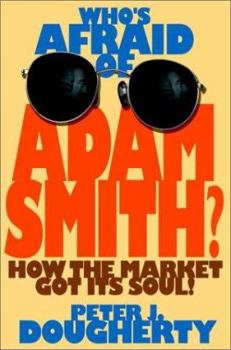
Who's Afraid of Adam Smith: How the Market Got Its Soul

Select Format
Select Condition 
Book Overview
"Peter Dougherty does the near-impossible in this brilliant book . . . [he] makes economics engaging and accessible." --Professor Larry J. Sabato, University of Virginia In this spirited and timely book, Peter Dougherty shows how economists are drawing on Adam Smith's civic writings to illuminate how the market creates not only fiscal capital, but "social capital." Dougherty demonstrates how Smith's ideas are currently experiencing a renaissance. He then explores several impressive initiatives to demonstrate what today's theoretical and practicing economists are accomplishing in the spirit of Adam Smith's moral sentiments: the institutional reform of transitional and developing economies; the financing of new technological, medical, and educational initiatives; and the economic revival of cities. Capitalism pervades every aspect of our daily life. Peter Dougherty now offers a fascinating peek at its hidden soul.
Format:Hardcover
Language:English
ISBN:0471184772
ISBN13:9780471184775
Release Date:August 2002
Publisher:Wiley & Sons, Incorporated, John
Length:240 Pages
Weight:1.03 lbs.
Dimensions:0.9" x 6.4" x 9.4"
Customer Reviews
4 ratings
Required Reading for Humanity
Published by Thriftbooks.com User , 20 years ago
The much maligned Adam Smith is herein exonerated as the great soul that he really is. Gandhi, Mother Teresa, King Jr. - these are reliable guides for those seeking to in whatever way make a difference with their lives. So is Smith. And this book is brilliant in its depiction of him. As noted throughout it's at the intersection of morals and money where our "modern day" society will find material wealth and spiritual fulfillment, the very legacy of Smith's "ism". This "ism" is in quotes here as it was not Smith that labeled his virtuous social system "capitalism" as we refer to it today, but rather Karl Marx as a to-this-day partially successful ploy to associate it with exploitation of workers and the poor while benefiting only the rich risk-taking capitalists. The legions of otherwise well-meaning "capitalism" bashers need only read this book to realize that any shortcomings manifesting in free market society today are not the fault of Smith's legacy but rather the fault of the individuals (you, me and our neighbors) who operate in it. This places the onus to improve our lots in life exactly where it should be, on ourselves -- not on anything or anyone "out there", and certainly not a social structure put together by a benevolent ancestor like Adam Smith. In the words of author Dougherty (a reliable source with decades of economics publishing experience and current Director of Princeton University Press), "The Smith we get to know in the years to come will be broader and more multifaceted a presence than the one we think we know." This book has been a huge help for me in this and more. And from Smith himself, "All the members of human society stand in need of each other's assistance, and are likewise exposed to mutual injuries. Where necessary assistance is reciprocally afforded from love, from gratitude, from friendship, and esteem, the society flourishes and is happy. All the different members of it are bound by the agreeable hands of love and affection, and are, as it were, drawn to one common centre of mutual good offices." Enjoy.
Highly Recommended!
Published by Thriftbooks.com User , 22 years ago
Peter J. Dougherty has written a breezy tour of modern economics, concentrating on attempts to reconnect the dismal science with its roots in civil studies and moral philosophy. Although he is not an economist, he displays an easy familiarity with economics' big ideas and their authors, and communicates them with style and wit. Dougherty's knowledge of the field is broad, thanks to his decades of experience as an economics editor, but thankfully he does not bog readers down in the technical details. His book stresses the importance of social capital as well as the profit motive, and of strong civic institutions and communities as well as corporations. He offers a refreshing perspective in an era of corporate scandals and cautionary tales of greed. This slim volume contains no specific lessons that can be applied by individuals, but rather a dose of hope that capitalism can indeed encourage the best in people and companies, when institutions and incentives are properly designed by a democratic society.We suggest this book to non-economists who want a quick course in the economic and social potential of democratic capitalism.
Adam Smith's Civil Society
Published by Thriftbooks.com User , 22 years ago
Who¡¯s Afraid of Adam Smith? How The Market Got Its Soul! is a book about economics. In the book Peter J. Dougherty portrays many important figures that shaped the history and evolvement of economics. He expresses the idea that economists are playing a more important role in the development of the modern world than what people have realized. However, this book is more about ethics. As the title tells, it is about the moral aspects of economics. With the discussion of Adam Smith¡¯s moral sentiment and how the moral aspects of economics evolved with the development of the modern society, Dougherty outlines the basis and inner morality of free market. He argues that capitalism system and the free market based on it was born with a soul.Adam Smith¡¯s The Wealth of Nation has long been regarded as the ¡°Bible of capitalism¡±. The focus of Dougherty¡¯s book, however, is on Smith¡¯s less-known book --- The Theory of Moral Sentiments. Published in 1759, The Theory of Moral Sentiments was derived from Adam Smith¡¯s work on moral philosophy. Dougherty believes that the moral dimension of Adam Smith gives market society its soul and it is further revised and updated by several generations of economists and social philosophers to meet the challenges of the changing time.Dougherty presents the facts that today¡¯s free market is running according to the basic rules Adam Smith articulated in his works. He points out that ¡°the seemingly paradoxical connection between self-love and universal opulence sat at the center of Smith¡¯s system of social philosophy¡¡± and ¡°Smith connected the pursuit of private interest to service of the public good.¡± He offers several important insights from Smith¡¯s idea of a civil society.A civil society is built around the assumption ¡°that we are not angels, but rather the very self-interested beings whom we know ourselves to be¡¡± As observed by Adam Smith it is "not from the benevolence of the butcher, the brewer, or the baker, that we expect our dinner, but from their regard to their own interest". A civil society is built on the basis of the pursuit of self-interest. It promotes individual prosperity.Adam Smith argued that the pursuit of self-interest would not only increase the wealth of the society but also inculcate good habits such as ¡°economy, industry, discretion, attention and application of thought¡±. As he noted ¡°whenever dealings are frequent, a man does not expect to gain so much by any one contract as by probity and punctuality in the whole, and a prudent dealer, who is sensible of his real interest, would rather choose to lost what he has a right to than give any ground for suspicion¡¡± In a civil society, these ¡°good habits¡± are not just an option, they are necessary for the maximization of people¡¯s self-interest.Finally, Dougherty discusses Adam Smith¡¯s idea on the role of government and other non-economic institutions in a society. He writes that ¡°we need institutions that channel our self-interest i
Great introduction to economics but only for open minded !
Published by Thriftbooks.com User , 23 years ago
You have no clue - or almost - about what economics is about but you believe that economists have a very limited "marginal utility". This book might change your point of view.Not written by economists but by their editor, this book provide a little guided tour through the classical and contemporary authors and their works. The authors key point - and I definitely agree with that - is that economists, from Freeman to friedman, are first and foremost concerned with social progress and in that respect, their contribution is tremendous.It is definitely not a detailled history of economic though ("the ordinary business of life" by R. Backhouse and edited by the author does it) but the book is full of great anecdotes about famous economists that deserve the purchase.In other word, if you are an economics graduate and do not dare to tell it to your girlfriend, you can offer her this book and she will push you to get the Ph.D ...For more advance reader the fantastic "the mind and the market" by Jerry Z. Muller, to whom the author - and the reader - acknowledged a big credit is also recomendedOne comment nevertheless : the author makes an excellent pitch for a few books but the one I looked for is not anymore available from the Princeton University Press, where the author works. The good point of that story, is that it confirms to me that this book is also driven by moral sentiments.
Copyright © 2026 Thriftbooks.com
Terms of Use | Privacy Policy | Do Not Sell/Share My Personal Information | Cookie Policy | Cookie Preferences | Accessibility Statement
ThriftBooks ® and the ThriftBooks ® logo are registered trademarks of Thrift Books Global, LLC
ThriftBooks ® and the ThriftBooks ® logo are registered trademarks of Thrift Books Global, LLC
