


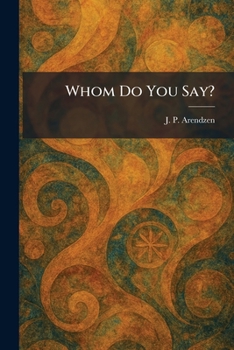
Whom Do You Say?

Select Format
Select Condition 
Book Overview
"Whom Do You Say?" is a profound theological exploration of the nature and divinity of Jesus Christ. Written by the esteemed scholar J.P. Arendzen, this work delves into the central question of the Christian faith: the identity of the Son of God. Through rigorous intellectual analysis and deep spiritual insight, the author examines the historical and scriptural foundations of Christology, addressing both the humanity and the divinity of Jesus.
Arendzen meticulously guides the reader through the doctrinal developments and theological arguments that have shaped the Catholic understanding of Christ. The book serves as a powerful defense of traditional Christian belief, providing clarity on complex concepts such as the Incarnation and the Hypostatic Union. Designed for both scholars and laypeople, "Whom Do You Say?" offers a comprehensive overview of how the Church perceives its founder and the implications of His mission for humanity.
This enduring work remains a significant contribution to religious literature, offering timeless reflections on the Person of Christ. It invites readers to contemplate the profound mystery of God made man and encourages a deeper personal engagement with the core tenets of the faith.
This work has been selected by scholars as being culturally important, and is part of the knowledge base of civilization as we know it. This work was reproduced from the original artifact, and remains as true to the original work as possible. Therefore, you may see the original copyright references, library stamps (as most of these works have been housed in our most important libraries around the world), and other notations in the work.
This work is in the public domain in the United States of America, and possibly other nations. Within the United States, you may freely copy and distribute this work, as no entity (individual or corporate) has a copyright on the body of the work.
As a reproduction of a historical artifact, this work may contain missing or blurred pages, poor pictures, errant marks, etc. Scholars believe, and we concur, that this work is important enough to be preserved, reproduced, and made generally available to the public. We appreciate your support of the preservation process, and thank you for being an important part of keeping this knowledge alive and relevant.
Customer Reviews
ThriftBooks ® and the ThriftBooks ® logo are registered trademarks of Thrift Books Global, LLC
