


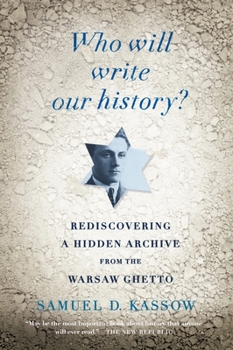
Who Will Write Our History?: Rediscovering a Hidden Archive from the Warsaw Ghetto

Select Format
Select Condition 
Book Overview
In 1940, the historian Emanuel Ringelblum established a clandestine organization, code named Oyneg Shabes, in Nazi-occupied Warsaw to study and document all facets of Jewish life in wartime Poland and... This description may be from another edition of this product.
Format:Paperback
Language:English
ISBN:0307455866
ISBN13:9780307455864
Release Date:January 2009
Publisher:Vintage
Length:576 Pages
Weight:1.64 lbs.
Dimensions:1.2" x 6.3" x 9.2"
Related Subjects
HistoryCustomer Reviews
5 ratings
Documenting a genocide
Published by Thriftbooks.com User , 15 years ago
I first became familiar with Emanuel Ringelblum when I read his excellent "Polish-Jewish Relations During the Second World War." Historian Ringelblum was the leader of the Oyneg Shabbos Archive group which documented the suffering and ultimate destruction of the Jewish inhabitants of the Warsaw Ghetto. "Who will write our history?" is an extremely well-researched history of Ringelblum and the Oyneg Shabbos Archive and their heroic effort to record the hellish existence of the ghetto's victims. Samuel Kassow's book is an important and moving contribution to Holocaust literature.
Interesting look at Warsaw Ghetto
Published by Thriftbooks.com User , 15 years ago
Kassow provided an interesting look at the Warsaw Ghetto, and the efforts of Emanuel Ringelblum, a Jewish historian, to chronicle what happened in it througout the Second World War through a collaboration with other Jews in an archive known as the Oyneg Shabes. The first third of the book details Ringelums pre-war life, including his political views, and was quite tedious to read, as it felt to be rather repetitive. After all, there is only so much that can be written about a historian, even if he has radical political and cultural views (which Ringelblum did to an extent). After that, it quickly increases pace, as the Oyneg Shabes works to record every aspect of the Warsaw Ghetto, from the smugglers who crossed the walls, to the way soup kitchens operated, even the types of music the Ghetto produced. It provides excellent details on anything to deal with the Ghetto, and has extensive footnotes and bibliography, totalling nearly 100 pages, for further research.
BRILLIANT
Published by Thriftbooks.com User , 16 years ago
MR Kassow proves himself a God among mere mortals. Unlike many historical volumes, Kassow's book reminds us of the dire importance of historiography and of the amazing capacity of history in shaping our lives. In exploring Ringelbaum's resistance Kassow illuminates the true courage and defiance of the Jewish, and the scholarly and perhaps more important method of resisting NAZI oppression. Count this as a historical piece that not only chronicles a fascinating story and time period, but also actually has something significant to say. Historians have never come of as vital to society as Kassow reminds us they are and have proven to be in this book. I'm out of breath by the complexity of this work, and of its constant reminder that no matter who we are, we can never be silenced. WOW
Civilization in Warsaw Ghetto
Published by Thriftbooks.com User , 16 years ago
A detailed report on the life, education and activities of Emmanuel Ringelblum and the Oyneg Shabes organization he headed, culminating in their detailed gathering of the history of Polish Jews throughout the course of the establishment and ultimate destruction of the Warsaw Ghetto. Despite fearsome hardships, and the transportation and murder of most of the hundreds of thousands of ghetto inhabitants who managed to survive starvation and disease, Ringelblum and his associates collected and preserved every sort of historical information they could obtain, commissioning hundreds of personal articles and testimonies by writers from all stations in life, and buried the records in three locations shortly before their own murder. Through the efforts of a very few survivors, the records were recovered from two of those locations after the war, and shine a painfully clear light on one example of the mechanics of inhumanity, as systematically chronicled by some of the intended victims of the Hitler regime. This volume is encyclopedic in scope, and has lovingly rendered in meticulous detail the history of the history-collection, and of the daily lives within the ghetto of those who accomplished it.
Tainted Ethnic Realities
Published by Thriftbooks.com User , 16 years ago
This book is important not just because of its main subject matter, the Oyneg Shabes archives, but also and more importantly for its larger more universal themes, questions, and the meanings they each evoke and force upon the conscience of all aspiring and struggling ethnics: themes about to what extent a struggling people can (if it can at all), and how it might (if there are any avenues to do so at all) go about, finally defining itself, for itself. If identity is destiny, then the Oyneg Shabes archives, more than anything else is about the destiny and deeper yearnings of the Jewish people. In this sense, the book is very much about how to define the complex and paradoxical Moibus strip of assimilation around which all group identities rather precariously and sensitively seem to revolve. As one traces his route around the strip in the mirror, every inch of the way he sees himself begin on the inside of the strip (assimilated) and miraculously no matter from where on the strip he might begin, nor how much he tries otherwise, or how carefully he watches his movements, he always ends up on the outside of the strip: Always ever the "outsider" in a reality not of his choosing, and invariably ending up as part of Jean Paul Sartre's proverbial discarded "Other." Through the most meticulous and carefully constructed and preserved history, under the most extreme of conditions, this book struggles with, and then attempts to answer the questions that all Jewish history has raised both for itself and as a proxy for other struggling peoples. It is what the many parables in the Old Testament speak about so elegantly: why it is that no matter how carefully the process is watched and managed, no matter how well the rules of societal existence are obeyed, (or even commandeered) despite all of their best efforts, Jews (and by extension all other similarily targeted and challenging ethnics) end up on the outside of the national drama, looking in? The short answer is a rather confusing paradox about reality itself: They end up that way because the rules that define the game; that is, the rules that describe the drama of heroism that is reality, are always existential, rather than merely semantic. The script, the rules of the game and the heroics they describe "are the reality." To try to get beyond them somehow to the script below by appealing to it from within, is to miss the most critical lesson about reality: reality is always about (and thus always preserves) that which is existential. One does not get outside the imperatives of existence by merely appealing to the rules that describe it from within. And while, as the Oyneg Shabes archive so aptly demonstrates, history is about "rewriting the script," that only raises a still deeper question: whose script? Whose existence is being protected? Whose identity is destiny? And most importantly what is the vehicle (whose drama of heroism) to carry such a unique identity? Thus, in sharp relief, this book raises
Copyright © 2026 Thriftbooks.com Terms of Use
| Privacy Policy | Do Not
Sell/Share My Personal Information | Cookie Policy | Cookie Preferences | Accessibility Statement
ThriftBooks® and the ThriftBooks® logo are registered trademarks of Thrift Books Global, LLC
ThriftBooks® and the ThriftBooks® logo are registered trademarks of Thrift Books Global, LLC
