


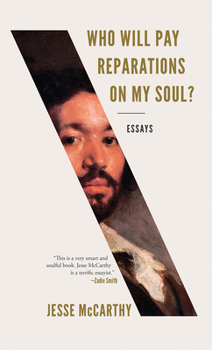
Who Will Pay Reparations on My Soul?: Essays

Select Format
Select Condition 
Book Overview
Ranging from Ta-Nehisi Coates's case for reparations to Toni Morrison's revolutionary humanism to D'Angelo's simmering blend of R&B and racial justice, Jesse McCarthy's bracing essays investigate with virtuosic intensity the art, music, literature, and political stances that have defined the twenty-first century. Even as our world has suffered through successive upheavals, McCarthy contends, "something was happening in the world of culture: a surging and unprecedented visibility at every level of black art making." Who Will Pay Reparations on My Soul? reckons with this resurgence, arguing for the central role of art and intellectual culture in an age of widening inequality and moral crisis.
McCarthy reinvigorates the essay form as a space not only for argument but for experimental writing that mixes and chops the old ways into new ones. In "Notes on Trap," he borrows a conceit from Susan Sontag to reveal the social and political significance of trap music, the drug-soaked strain of Southern hip-hop that, as he puts it, is "the funeral music that the Reagan Revolution deserves." In "Back in the Day," McCarthy, a black American raised in France, evokes his childhood in Paris through an elegiac account of French rap in the 1990s. In "The Master's Tools," the relationship between Spanish painter Diego Vel?zquez and his acolyte-slave, Juan de Pareja, becomes the lens through which Kehinde Wiley's paintings are viewed, while "To Make a Poet Black" explores the hidden blackness of Sappho and the erotic power of Phillis Wheatley. Essays on John Edgar Wideman, Claudia Rankine, and Colson Whitehead survey the state of black letters. In his title essay, McCarthy takes on the question of reparations, arguing that true progress will not come until Americans remake their institutions in the service of true equality. As he asks, "What can reparations mean when the damage cannot be accounted for in the only system of accounting that a society recognizes?"
For readers of Teju Cole's Known and Strange Things and Mark Greif's Against Everything, McCarthy's essays portray a brilliant young critic at work, making sense of our disjointed times while seeking to transform our understanding of race and art, identity and representation.
Customer Reviews
ThriftBooks® and the ThriftBooks® logo are registered trademarks of Thrift Books Global, LLC
