


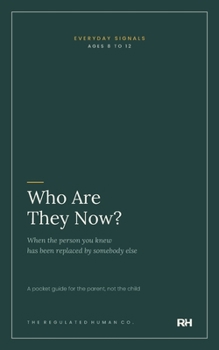
Who Are They Now?

Not losing them. Meeting them.
It happens in a small moment rather than a large one. They walk past and something in the way they move is not the person you have been carrying around in your head - and you catch yourself thinking, plainly and without alarm, I do not know who this is.
The things that used to work have stopped working. The thing you always did on Saturdays. The joke that always landed.
And there is nowhere to put it. Nothing is wrong. They are well, mostly happy, and doing fine. There is no problem to raise with anybody, which is exactly why it sits there.
A short book about the stranger in your kitchen.
What is in it:
Three things that arrive at once and get experienced as one large unnameable change - opinions arriving from somewhere that is not you, being evaluated for the first time, and the shared things quietly expiring.
Why whatever you did together was built on their being six, and what happens when they stop being six.
What is still the same, which is worth listing because the changes are loud and these are quiet. Where they go when something is wrong. How they are with somebody younger - watch them with a smaller cousin and the person you think has gone is entirely present.
Why performing nostalgia lands as a bill. "You used to love this" asks them to be somebody they are not, and to apologise for it.
Why keeping the old activity going past its natural end turns it into an obligation.
Taking an interest in the new thing, badly. Not pretending to like it. Asking how it works and being visibly terrible at it.
Keeping one fixture that does not depend on mood.
Being interruptible, because they come and talk at the worst possible moment, briefly, about nothing.
Taking a photograph now. Nobody photographs eleven.
The second relationship - because what is being built is not a repair. The first was with a small child who needed you entirely. That one has ended, on schedule, and it was always going to. The second is with a person who does not need you in the same way and may, in time, quite like you.
And the part that has nothing to do with them. For about a decade you were required constantly. When that is withdrawn - gradually, without ceremony, by somebody simply getting on with things - what is left is a question about who you are when nobody needs you every twenty minutes.
Which is why the most useful item in the book is the one that looks least relevant. Find your own thing back. The one that got put down when they were small.
The grief that has no name. Nobody offers condolences for this, because from outside it looks exactly like everything going well. It is going well. And something has ended. Both are true at once, and being unable to say the second one out loud is most of what makes it heavy.
Nothing here to do tomorrow. This one is not about your child.
The one you miss is not coming back. The one in the kitchen is worth knowing.
"Ask how the game works."
For the parent, not the child. Sixty-four pages, small enough for a coat pocket.
This book supports everyday emotional awareness. It is not a screening tool and it is not a substitute for professional guidance.
Everyday Signals: short guides for the hard bits of an ordinary day. No quick fixes. No hype. Regulation before optimisation.
Related Subjects
Parenting & RelationshipsCustomer Reviews
ThriftBooks ® and the ThriftBooks ® logo are registered trademarks of Thrift Books Global, LLC
