


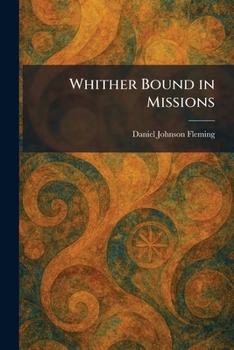
Whither Bound in Missions

Select Format
Select Condition 
Book Overview
In "Whither Bound in Missions", Daniel Johnson Fleming offers a profound and forward-looking examination of the Christian missionary movement during a period of significant global transition. Writing at a time when traditional approaches to international religious work were being challenged by changing political and social realities, Fleming explores the evolving philosophy and practical direction of the missionary enterprise.
The work delves into critical questions regarding the relationship between Western churches and the growing Christian communities in Asia and Africa. Rather than viewing missions as a one-way transfer of dogma, Fleming advocates for a more collaborative, reciprocal, and culturally sensitive approach. He emphasizes the need for a deeper understanding of indigenous cultures and a shift toward local leadership, reflecting a broader movement toward religious internationalism and ecumenical cooperation.
Addressing both the spiritual motivations and the social responsibilities of the church, "Whither Bound in Missions" remains a significant historical document for those interested in the development of modern missiology. It provides valuable insight into the theological debates of the early 20th century and the foundational shifts that helped shape the contemporary landscape of global Christianity. This thoughtful analysis serves as both a critique of past methods and a visionary roadmap for the future of religious service.
This work has been selected by scholars as being culturally important, and is part of the knowledge base of civilization as we know it. This work was reproduced from the original artifact, and remains as true to the original work as possible. Therefore, you may see the original copyright references, library stamps (as most of these works have been housed in our most important libraries around the world), and other notations in the work.
This work is in the public domain in the United States of America, and possibly other nations. Within the United States, you may freely copy and distribute this work, as no entity (individual or corporate) has a copyright on the body of the work.
As a reproduction of a historical artifact, this work may contain missing or blurred pages, poor pictures, errant marks, etc. Scholars believe, and we concur, that this work is important enough to be preserved, reproduced, and made generally available to the public. We appreciate your support of the preservation process, and thank you for being an important part of keeping this knowledge alive and relevant.
Customer Reviews
ThriftBooks ® and the ThriftBooks ® logo are registered trademarks of Thrift Books Global, LLC
