


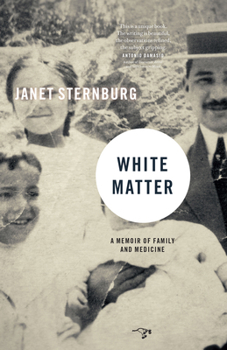
White Matter: A Memoir of Family and Medicine
No Customer Reviews

One close-knit Bostonian Jewish working-class family of five sisters and one brother is forced to endure an outsized impact--and create a complicated legacy--as the popularity of lobotomy grows during the 20th century When Janet Sternburg's grandfather abandoned his family, and her uncle, Bennie, became increasing mentally ill, Sternburg's mother and aunts had to bind together and make crucial decisions for the family's survival. Two of the toughest familial decisions they made were to have Bennie undergo a lobotomy to treat his schizophrenia and later to have youngest sister, Francie, undergo the same procedure to treat severe depression. Both heartrending decisions were largely a result of misinformation disseminated that legitimized lobotomy. Woven into Sternburg's story are notable figures that influenced the family as well as the entire medical field. In 1949, Egas Moniz was awarded the Nobel Prize in Medicine for developing the lobotomy, and in the three years that followed his acceptance of the award, more Americans underwent the surgery than during the previous 14 years. By the early 1950s, Walter Freeman developed an alternate technique for lobotomy, which he proselytized during his travels throughout the country in a van he dubbed the "Lobotomobile." The phrase "prefrontal lobotomy" was common currency growing up in Janet Sternburg's family. In White Matter she details this scientific discovery that disconnects the brain's white matter, leaving a person without feelings, and its undeserved legitimization and impact on her family. She writes as a daughter consumed with questions about her mother and aunts--all well meaning women who decided their siblings' mental health issues would be best treated with lobotomies. By the late 1970s, the surgical practice was almost completely out of favor, but its effects left a stain on American medical history. Every generation has to make its own medical choices based on knowledge that will inevitably come to seem inadequate in the future. How do we live with our choices when we see their consequences?
Format:Paperback
Language:English
ISBN:0989360490
ISBN13:9780989360494
Release Date:September 2015
Publisher:Hawthorne Books
Length:232 Pages
Weight:0.84 lbs.
Dimensions:0.6" x 5.6" x 9.0"
Customer Reviews
0 rating
Copyright © 2026 Thriftbooks.com Terms of Use
| Privacy Policy | Do Not
Sell/Share My Personal Information | Cookie Policy | Cookie Preferences | Accessibility Statement
ThriftBooks® and the ThriftBooks® logo are registered trademarks of Thrift Books Global, LLC
ThriftBooks® and the ThriftBooks® logo are registered trademarks of Thrift Books Global, LLC
