


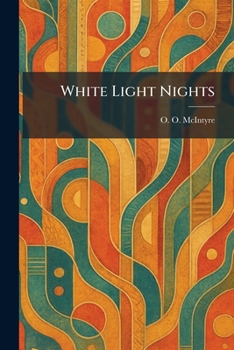
White Light Nights

Select Format
Select Condition 
Book Overview
"White Light Nights" is a captivating collection of urban sketches and observations that transport readers to the heart of New York City during the roaring twenties. Written by the renowned columnist O. O. McIntyre, this work serves as a vibrant tapestry of Manhattan life, focusing on the glitz, glamour, and grit of the Broadway theater district and its surrounding nocturnal world.
Through a series of evocative essays, McIntyre captures the essence of the Jazz Age, painting vivid portraits of the dreamers, celebrities, and eccentrics who populated the "Great White Way." The book explores the shifting social landscape of the post-war era, offering a unique perspective on the evolution of American urban culture. From the dazzle of the footlights to the quiet corners of the city's many neighborhoods, McIntyre's prose is characterized by its wit, keen eye for detail, and a deep-seated affection for the metropolis.
"White Light Nights" stands as a significant historical and literary document, reflecting the spirit of an era defined by rapid change and unbridled energy. It remains an essential read for those interested in the history of New York City, the development of the American personal essay, and the enduring allure of the city that never sleeps.
This work has been selected by scholars as being culturally important, and is part of the knowledge base of civilization as we know it. This work was reproduced from the original artifact, and remains as true to the original work as possible. Therefore, you may see the original copyright references, library stamps (as most of these works have been housed in our most important libraries around the world), and other notations in the work.
This work is in the public domain in the United States of America, and possibly other nations. Within the United States, you may freely copy and distribute this work, as no entity (individual or corporate) has a copyright on the body of the work.
As a reproduction of a historical artifact, this work may contain missing or blurred pages, poor pictures, errant marks, etc. Scholars believe, and we concur, that this work is important enough to be preserved, reproduced, and made generally available to the public. We appreciate your support of the preservation process, and thank you for being an important part of keeping this knowledge alive and relevant.
Customer Reviews
ThriftBooks ® and the ThriftBooks ® logo are registered trademarks of Thrift Books Global, LLC
