


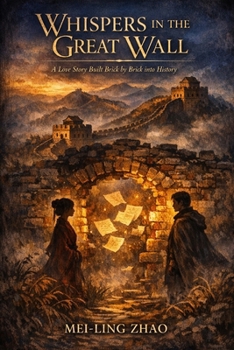
Whispers in the Great Wall: A Love Story Built Brick by Brick into History

Some walls are built to keep the world out. This one kept a love story in.
When Dr. Lin Yujia arrives in Beijing on a routine heritage survey assignment, she carries two suitcases and a carefully guarded heart. Fourteen months out of a marriage that quietly broke her, she has rebuilt herself into someone useful, precise, and determinedly closed. The Great Wall, she tells herself, is a professional subject. Nothing more.
But the Wall has other intentions.
Deep inside an unexcavated Ming Dynasty watchtower, Lin's team discovers a sealed chamber untouched for four hundred years. Inside: forty-seven letters, pressed between oilcloth and ceramic jars, written across five years by a conscripted mason named Wei Liang to a woman named Chen Shulan who waited for him five hundred kilometers away. As Lin translates their correspondence word by careful word, she finds herself reading not only the story of two people who loved each other across an impossible distance, but a mirror of everything she has been afraid to want again.
Shifting between present-day Beijing and the mid-Ming Dynasty frontier of 1562 to 1579, Whispers in the Great Wall is a novel about what survives when everything else falls. It is about the courage of ordinary people building extraordinary things with their hands, and the even greater courage of reaching toward another person and saying: I am here. It is about letters that crossed five hundred kilometers and lasted four centuries because someone believed, without certainty, that they deserved to last.
And it is about a woman standing on an ancient ridgeline, in the cold October wind, placing her fingertips on a stone that has been waiting since 1568, and understanding, for the first time in over a year, that the distance between where she is and where she wants to be is not the kind that is final.
Wei Liang trusted the future. The future was right to be trusted.
Customer Reviews
ThriftBooks ® and the ThriftBooks ® logo are registered trademarks of Thrift Books Global, LLC
