


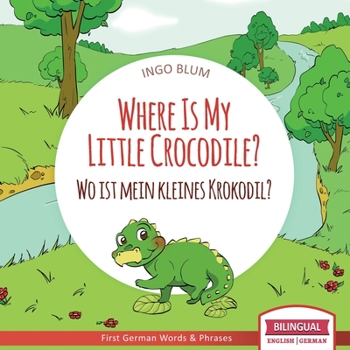
Where Is My Little Crocodile? - Wo ist mein kleines Krokodil?: English German Bilingual Children's picture Book
(Book #1 in the Where is... Series)
No Customer Reviews

Select Format
Select Condition 
Book Overview
Teach Your Children First Words In German.
Are you looking for your crocodile? The search for a little crocodile named Charlie in different places is a delightful read-aloud. Can Charlie drive a car? Is he allowed to eat in restaurants? Is he dangerous? Where did he go? This book is perfect for kids learning English or German as their second language. Kids will learn different places, objects, and simple questions and answers, but mostly, they will cry out a loud "hooray" when the funny crocodile is discovered at the end. Where? Well, just read . . . The print version of this book includes 4 extra pages for coloring! _________ TOP REVIEWERS FROM AMAZON SAY: ★★★★★ "Lovely bilingual book."
★★★★★ "Colorful, Delightful, Language Learning."
★★★★★ "Great for learning German."
★★★★★ "Great for everyone."
★★★★★ "Adorable."
★★★★★ "Fun bedtime book."
★★★★★ "Delightful bedtime story to read to young children."
★★★★★ "Awesome and so cute."
★★★★★ "Darling story!"
Are you looking for your crocodile? The search for a little crocodile named Charlie in different places is a delightful read-aloud. Can Charlie drive a car? Is he allowed to eat in restaurants? Is he dangerous? Where did he go? This book is perfect for kids learning English or German as their second language. Kids will learn different places, objects, and simple questions and answers, but mostly, they will cry out a loud "hooray" when the funny crocodile is discovered at the end. Where? Well, just read . . . The print version of this book includes 4 extra pages for coloring! _________ TOP REVIEWERS FROM AMAZON SAY: ★★★★★ "Lovely bilingual book."
★★★★★ "Colorful, Delightful, Language Learning."
★★★★★ "Great for learning German."
★★★★★ "Great for everyone."
★★★★★ "Adorable."
★★★★★ "Fun bedtime book."
★★★★★ "Delightful bedtime story to read to young children."
★★★★★ "Awesome and so cute."
★★★★★ "Darling story!"
Format:Paperback
Language:English
ISBN:1982922575
ISBN13:9781982922573
Release Date:June 2018
Publisher:Independently Published
Length:34 Pages
Weight:0.11 lbs.
Dimensions:0.1" x 8.5" x 8.5"
Customer Reviews
0 rating
Copyright © 2026 Thriftbooks.com Terms of Use
| Privacy Policy | Do Not
Sell/Share My Personal Information | Cookie Policy | Cookie Preferences | Accessibility Statement
ThriftBooks® and the ThriftBooks® logo are registered trademarks of Thrift Books Global, LLC
ThriftBooks® and the ThriftBooks® logo are registered trademarks of Thrift Books Global, LLC
