


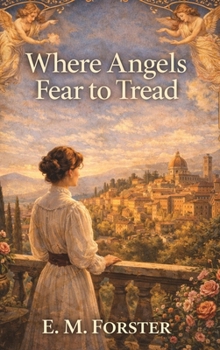
Where Angels Fear to Tread


Select Format
Select Condition 
Book Overview
Where Angels Fear to Tread is a sharp and emotionally rich novel that explores the clash between rigid social conventions and the unpredictability of human feeling. When a young English widow travels to Italy and makes an unexpected decision that shocks her conservative family, the consequences ripple across cultures and relationships. E. M. Forster contrasts the warmth, spontaneity, and passion of Italian life with the restraint and propriety of Edwardian England, creating a story filled with tension, irony, and quiet tragedy. His characters are deeply human-flawed, conflicted, and often caught between duty and desire. With subtle humor and keen observation, Forster examines themes of freedom, judgment, and the limits of societal control. Both engaging and thought-provoking, this novel remains a powerful reflection on the risks of living too cautiously-and the cost of ignoring the heart.
Format:Hardcover
Language:English
ISBN:937864080X
ISBN13:9789378640803
Release Date:April 2026
Publisher:Kalamos Literary Services Llp
Length:126 Pages
Weight:0.75 lbs.
Dimensions:0.4" x 6.0" x 9.0"
Customer Reviews
4 ratings
What I remembered
Published by Thriftbooks.com User , 18 years ago
What I remembered from this novel was the opera scene (still glorious) and the tragic climax (still brutal so that I slowed down coming up to it in hopes of preventing its appearance). What I forgot was how witty it was, how warm, how accomplished for such an early novel in a writer's career. In short, it was actually better than I remembered, a rare accomplishment for an author I love so much. Not as magnificent as Proust nor as fine a writer as James, but equally as wise as both and much more welcoming than either.
Where Angels Fear to Tread
Published by Thriftbooks.com User , 19 years ago
In E. M. Forster's first novel, an effete English family and their acquaintances encounter an authentic and vital society in the hills of Italy. Vacuous Lilia visits Monteriano in Tuscany and impulsively marries. She realizes her mistake too late to save herself but her English in-laws attempt to rescue the issue of her marriage. Upon arriving in Monteriano, they find that their wealth and education count for less than they thought. Rigid Harriett breaks herself against the local culture and provokes a tragedy, but the more sensitive members of the rescue party, Philip and Miss Abbott, profit in ways that they did not expect. Forster uses a quiet, simple style that lets the reader be moved by his rather sudden plot revelations. While this is a short novel, Forster finds room for a sincere appreciation of the charms of fictional Monteriano and some gentle humor. I imagine that this very approachable novel would appeal to many different types of readers.
Italy Charms Everyone in the Worst of Times [98]
Published by Thriftbooks.com User , 19 years ago
If one wishes to learn how Britain's rich entertained, lived and acted during the turn of the century, E.M. Forster and Evelyn Waugh deliver depictions as well as anyone of their generation. This book delves little with interpersonal thoughts. Instead, it deals with dialogue. Rich, gooey, luscious dialogue where the characters reveal their characters, their thoughts, their inner beings by what words they choose to deliver to others. In the staid world of turn-of-the-century Britain, the dialogue must be masterfully written as the people did not directly say what they felt. They were polite, but in a cold British manner. And, Forster's ability to write that type of British dialogue is unrivaled. Additionally, this book - which is amid the wonderfully warm Italy - delivers a great ethical question: what to do with a baby born of a British mother (who dies in child birth) related to very impudent and snobby persons residing in the outskirts of London. Who does he belong to? His wealthy British relatives where he will be brought up well but little loved? Or with his loving Italian stallion 23-year-old father who has little money, knows nothing of rearing children and probably would fail (at least in a British perspective) in raising the child? Forster delivered a similar ethical issue in "Howards End" where the last wish of a dying wife to her husband of many years (through oral bequest and written - but unwitnessed note - which contradicts her written will) is not followed by her husband and family who wish to keep their inheritance in exchange for dishonoring the matriarch's last wishes. But, each issue is not finished with the sudden first response. In each book, more events occur which gloss the issue. Read this book soon in time to "A Room With A View." Italy obviously touched Forster - this book and "Room With A View" are its derivatives. Thank you Italy for being you to Forster, who wrote that Italy ". . . sent me going as novelist."
Forster's first - and his best!
Published by Thriftbooks.com User , 26 years ago
This is by far my favorite novel by Forster, and many rereadings have made it one of my favorite novels, period. In his first book, Forster shows a subtlety and lightness of touch which I, at least, feel that he lost as he got more self-consciously "philosophical" in later books like Howard's End and A Passage to India. He makes wonderful use of the Italian settings and of Italian art, bringing them to vivid life, undermining tourist cliches, and weaving them gracefully into his main themes. No other book I know balances romanticism and irony so perfectly.
Copyright © 2026 Thriftbooks.com
Terms of Use | Privacy Policy | Do Not Sell/Share My Personal Information | Cookie Notice | Cookie Preferences | Accessibility Statement
ThriftBooks ® and the ThriftBooks ® logo are registered trademarks of Thrift Books Global, LLC
ThriftBooks ® and the ThriftBooks ® logo are registered trademarks of Thrift Books Global, LLC
