


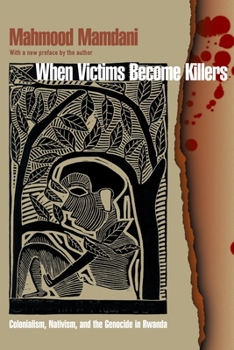
When Victims Become Killers: Colonialism, Nativism, and the Genocide in Rwanda

Select Format
Select Condition 
Book Overview
An incisive look at the causes and consequences of the Rwandan genocide
"When we captured Kigali, we thought we would face criminals in the state; instead, we faced a criminal population." So a political commissar in the Rwanda Patriotic Front reflected after the 1994 massacre of as many as one million Tutsis in Rwanda. Underlying his statement was the realization that, though ordered by a minority of state functionaries, the slaughter was performed by hundreds of thousands of ordinary citizens, including judges, doctors, priests, and friends. Rejecting easy explanations of the Rwandan genocide as a mysterious evil force that was bizarrely unleashed, When Victims Become Killers situates the tragedy in its proper context. Mahmood Mamdani coaxes to the surface the historical, geographical, and political forces that made it possible for so many Hutus to turn so brutally on their neighbors. In so doing, Mamdani usefully broadens understandings of citizenship and political identity in postcolonial Africa and provides a direction for preventing similar future tragedies.Format:Paperback
Language:English
ISBN:0691192340
ISBN13:9780691192345
Release Date:January 2020
Publisher:Princeton University Press
Length:392 Pages
Weight:1.30 lbs.
Dimensions:1.0" x 6.0" x 9.0"
Related Subjects
Africa African-American Studies Civilization & Culture Comparative Politics Government History Legal Theory & Systems Literary Literary Criticism & Collections Literature Literature & Fiction Military Science Modern (16th-21st Centuries) Non-US Legal Systems Political History Political Science Politics & Government Politics & Social Sciences Rwanda Social Science Social Sciences Specific Demographics Violence in Society WorldCustomer Reviews
5 ratings
When Victims become killers
Published by Thriftbooks.com User , 20 years ago
A great book that is doing justice to the people that were rudely touched by the genocide. History plays a great part in influencing and explaining particular events that happen in the present but many people forget and view the event as inexplicable. Those who forget to ask the 'why' question are always liable to repeat the blunders of history since they never learn from its ugly mistakes. Prof. Mamdani is trying to undo this mistake. Many, especially in the west from their self righteous pedestal, look at the Rwandan genocide and judge. Mamdani goes behind the scenes of history to dig out the 'why' of this ugliest of human ventures. Drawing heavily on Franz Fanon, he casts a wide net covering the whole Great Lakes Region and Colonialism through the cold war, to tell us that the victims of injustice can only be free if they kill the oppressor. To become human they must deny life to the oppressor. The irony is, to overcome the monster of injustice, you must surpass its monstrosity, leading to the cycle of violence. Americans who read this book will come to understand better the whyness of 9/11; the Europeans will understand Hitler and Africans will grasp the whyness of so many coup d'etats, and finally an insight that is long overdue will dawn on us all and we will see the light. We will understand that without justice in the world those who work for peace labor but in vain. A must read book for serious peacemakers.
Reform the state and citizenship
Published by Thriftbooks.com User , 21 years ago
Mahmood Mamdani is Professor of Government and Director of the Institute of African Studies at Columbia University. His reputation as an expert in African history, politics and international relations has made him an important voice in contemporary debates about the changing role of Africa in a global context. Mamdani proposes that Burundi and Rwanda need to reform the state and citizenship within their own borders so that power recognizes equal citizenship rights for all based on a single criterion: residence. Without a reform in power, one that recognizes both the importance of a majority in politics and the need for fearful minorities to participate in the exercise of power, Mamdani maintains there can be no sustained reconciliation between Hutu and Tutsi. Reviewed by David S. Fick, Author of Africa: Continent of Economic Opportunities, STE Publishers, Johannesburg SA, May 2005, www.ste.co.za
A good account of Rwandan history from within.
Published by Thriftbooks.com User , 23 years ago
Well written, very good explanation why it happened on such a massive scale. Most of us have a kind of feelling that "history" happened in the past and somewhere far away. This books tells how history is made today, giving the insight into the regional context of the confict (Congo)...
When Victims Become Killers: Colonialism, Nativism, and the
Published by Thriftbooks.com User , 23 years ago
The Rwandan genocide was a horrible affair of unequal proportions. I have always wondered though how a whole population can commit such horrendous acts against fellow countrymen/women en masse, as was reported. Surely there must've been something that must've been brewing all along; there must've been an underlying "cause". Despeakable it maybe I wanted to know what in Rwanda's history could've given rise to this. I have read Phillip Gourevitch'sr "We Wish to Inform You That Tomorrow We Will be Killed With Our Families: Stories from Rwanda", although a good book, is mostly a narrative and I was still left with the unfinished business of why? why? why?. This book filled the void for me. With a historical background of precolonial, colonial, and postcolonial sociopolitical Rwanda, the author provides an amazingly rich analysis of the Rwandan state leading to what heppened in 1994. It has given me the picture I needed to see, to begin to address the issues of why did this awful thing took place. It's a must read to anyone interested in Rwanda and what went on there.
Should become the standard English-language introduction
Published by Thriftbooks.com User , 24 years ago
This new book by Mahmood Mamdani, one of the world's most respected Africa scholars, stands a good chance of replacing Gérard Prunier's "The Rwanda Crisis" as the standard English-language introduction to Rwanda and its genocide. Mamdani's highly-readable account focuses on the political construction of Hutu and Tutsi as racial/ethnic identities, tracing the tale from the pre-colonial era, through Belgium's administration of the country, to the 1959 Revolution and subsequent attempts to develop an overarching sense of Rwandan nationhood. These attempts were cut short by the rise of Hutu Power in the early 1990s, culminating in the horrific outbreak of mass killing in April 1994. The advantage of Mamdani's book is that it offers "history from below," arguing that the racialized hostility between Hutu and Tutsi helps to account for the extraordinary (perhaps unprecedented) degree of popular involvement in the 1994 killing campaign. He also stresses the regional context of the Rwandan civil war and genocide, with separate chapters on Uganda and Congo/Zaire. The book is rich in theoretical insights but never ponderous or pretentious. A "must" for any student of Rwanda or modern African politics more generally (see also Mamdani's award-winning 1996 book "Citizen and Subject," which fleshes out some of the theoretical frameworks used in "When Victims Become Killers").
Copyright © 2026 Thriftbooks.com Terms of Use
| Privacy Policy | Do Not
Sell/Share My Personal Information | Cookie Policy | Cookie Preferences | Accessibility Statement
ThriftBooks® and the ThriftBooks® logo are registered trademarks of Thrift Books Global, LLC
ThriftBooks® and the ThriftBooks® logo are registered trademarks of Thrift Books Global, LLC
