


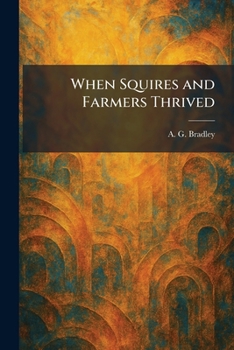
When Squires and Farmers Thrived

"When Squires and Farmers Thrived" is a vivid and nostalgic exploration of the English countryside during the mid-Victorian era. Written by A.G. Bradley, a noted chronicler of rural England, the work provides an intimate portrait of a lost world where the squirearchy and the farming community formed the backbone of provincial society.
The book delves into the social structures, agricultural practices, and local traditions that defined life in the mid-19th century, capturing the essence of a period often regarded as the golden age of English farming. Bradley combines personal reminiscence with historical observation, detailing the rhythms of the seasons, the importance of the harvest, and the complex relationships between landowners and their tenants.
Through engaging prose, the narrative transports the reader to a time of stability and prosperity in the rural heartlands, offering valuable insights into the social history and topography of the British Isles. This work remains an essential resource for those interested in the evolution of the English landscape and the cultural heritage of its inhabitants.
This work has been selected by scholars as being culturally important, and is part of the knowledge base of civilization as we know it. This work was reproduced from the original artifact, and remains as true to the original work as possible. Therefore, you may see the original copyright references, library stamps (as most of these works have been housed in our most important libraries around the world), and other notations in the work.
This work is in the public domain in the United States of America, and possibly other nations. Within the United States, you may freely copy and distribute this work, as no entity (individual or corporate) has a copyright on the body of the work.
As a reproduction of a historical artifact, this work may contain missing or blurred pages, poor pictures, errant marks, etc. Scholars believe, and we concur, that this work is important enough to be preserved, reproduced, and made generally available to the public. We appreciate your support of the preservation process, and thank you for being an important part of keeping this knowledge alive and relevant.
Customer Reviews
ThriftBooks ® and the ThriftBooks ® logo are registered trademarks of Thrift Books Global, LLC
