


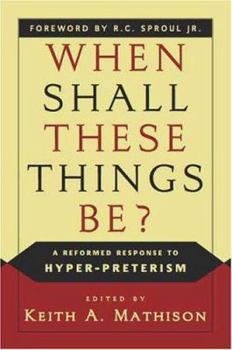
When Shall These Things Be?: A Reformed Response to Hyper-Preterism

"Full Preterists," contending that all biblical prophecy was fulfilled in the first century, have gained an avid following for their eschatological views. But does their zeal for the past fulfillment... This description may be from another edition of this product.
Format:Paperback
Language:English
ISBN:0875525520
ISBN13:9780875525525
Release Date:August 2019
Publisher:P & R Publishing
Length:376 Pages
Weight:1.20 lbs.
Dimensions:0.8" x 6.2" x 9.0"
Related Subjects
Christian Books & Bibles Ethics Religion Religion & Spirituality Religious Studies TheologyCustomer Reviews
5 ratings
Avoiding prophetic disaster
Published by Thriftbooks.com User , 22 years ago
Here is a book a friend of my loaned me awhile back. I had heard that a new doctrine was arising in some Christian circles. This new doctrine teaches that Christ has already returned and that Christians have already been resurrected. I couldn't believe my friend's allegations at first, but this book did a marvelous job in documenting the heresy beginning to circulate.Mathison is an employee of Dr. R. C. Sproul, one of my favorite theologians. Mathison has written other books which I enjoy. I am glad he has assembled this group of theologians to expose hyper-preterism. They did a wonderful job.I was especially thankful that the book put the heretical problem in historical context. As Christians we often tend to approach Scripture individualistically, as if we were the final judge of truth and error. But the chapter on creeds (ch. 1), on history (ch. 2), and on the canon of the NT (ch. 6) were extremely helpful. These chapters remind us that not everyone who thumps the Bible loudly is being true to Scripture.I also found several of the earlier reviews very interesting. It seems obvious that some group called "Healing Leaves" is making a concerted effort to keep Christians from reading the book. And judging from the character of their reviews, I believe it is easy to see another reason for alarm with this new movement.For some inexplicable reason, the hyperpreterist reviewers of this book only mention Mathison and Gentry -- two of the seven authors in this work. The other five hold prominent positions in theological seminaries. It is odd that they generally attack only Gentry and Mathison (who are both holders of master's degrees in theology from Reformed Theological Seminary, as well as doctoral degrees from Whitefield Seminary). It is odd because Gentry and Mathison are preteristic in many respects. Obviously it is painful for hyperpreterists to see that some of their positions can be fitted into evangelical theology without becoming heretical.I recommend getting this book and using it as a small group Bible study guide. There is much in it that helps understand this new pseudo-biblical movement. I believe your friends would be interested in studying it -- just for practice in witnessing to cults.
Bravo! Reformed Scholars Defend Orthodox Christianity!
Published by Thriftbooks.com User , 22 years ago
It is certain that wolves wear sheep's clothing. This attire is not for beauty, but deception unto destruction. This new book lifts the fleece and allows the reader to see that the hyper-preterism position beneath is wolf-like. This unorthodox twist on eschatology denies essential tenets of the Christian faith. Those who hold such positions are not friends of the Good Shepherd, and certainly have no love for His sheep. This book reveals the wolf and protects the sheep. In this regard, it accords with the ministry of the Savior.The view critiqued in this book holds that there is no bodily resurrection and no future literal second coming of Jesus Christ. Yet, adherants to the nonsensical views of hyper-preterism desire to wear the tag "Orthodox Christian". Those who deny the essential tenets of the faith once for all delivered to the saints are neither orthodox nor Christian. This book reveals wolves for what they are - wolves. Dr. Gentry begins by giving more than ample evidence that the historic position of the church is well-stated and clear. To deny the weight or his thorough documentation is to demonstrate an unwillingness to see the evidence. Hyper-preterism is a novelty. Any movement that desires to isolate itself from the universal confessions of the faith should be seen as suspect. Gentry clearly shows that this infantile position is not historically represented within orthodoxy. Dr. Hill's chapter is also well-documented and convincing. He does an excellent job of evaluating extra-Biblical material in the years immediately following the age of the apostles. The view of the hyper-preterists is not in this writing. Thus, as Dr. Hill states, it either was not taught, or the apostles were unable to pass on the body of doctrinal truth that Jesus entrusted unto them. Dr. Hill shows that the hyper-preterism position states that the age of fulfillment came in AD 70, yet no writers can show that this occurred in the early church record. This is a devastating critique. The only way to avoid its impact is to make the opinions of isolated individualism the determining factor of exegetical soundness - a rather tenuous position.Dr. Pratt also does a marvelous job of showing that prophetic fulfillment is not always easy to discern due to intervening historical contingencies. His handling of the seventy year prophecy in Jeremiah's writing displays a masterful holistic approach to interpreting the text. Dr. Pratt reveals that it is not simple to determine the outworking of the time texts of Scripture. Often there are intervening circumstances that are not clear. His chapter shows that one premise of hyper-preterism (that the time texts of the New Testament are clear and easily discernable) is not as stable as one might imagine. Dr. Mathison also reveals the many ways respected scholarship handles the time texts of the Scriptures. His thorough discussion leaves one humbled by the various acceptable views, yet confident that ort
Wonderful book
Published by Thriftbooks.com User , 22 years ago
I was delighted to read this wonderful book. Our church had someone who got mixed up in the Hyper-preterist movement. He became one-track in his thinking and really became a pest. He eventually was ministered to, and forsook this cultic movement.This book was helpful in showing how the Hyper-preterists distort Scripture. Strimple's chapter was worth the whole book. He showed how the HPs are all over the map on the fundamental doctrine of the resurrection. Something so clear and simple becomes so confusing in the Hyper-preterist view.Hill's chapter was also insightful: If the great transition between the old creation and new creation occurred in A.D. 70, why didn't anyone coming through that period know about it. Were the apostles that bad in their teaching that no one could figure it out for 2000 years?Gentry's chapter showed that Christianity has always had a core theology throughout its history. The Hyper-preterists expect the whole Christian church to toss out the historic doctrines of the faith on the basis of their bizarre views. He even pointed out that some of them are beginning to deny the doctrine of hell and the ministry of the Holy Spirit in this age.Wilson turned the tables on them. The Hyper-preterists claim "Sola Scriptura" as their motto. They deny any recourse to the traditional church's doctrine. But he showed that the Hyper-preterists cannot tell you why there are 66 books and only 66 books in the Bible on the basis of their supposed "Sola Scriptura." Where in the Bible do we learn there are 66 books? Excellent! Get this book to help you witness to Hyper-preterists. I have seen at least one turn his life around. I know of others who have, as well.
DEFENDING HISTORIC CHRISTIANITY
Published by Thriftbooks.com User , 22 years ago
Finally a nationally noted publisher has engaged the debate against a new Internet-based theological movement. In "When Shall These Things Be" we find a book by several noted evangelical and Reformed scholars who throw a spotlight on the growing Hyperpreterist movement. I am thankful that Keith Mathison of R. C. Sproul's Ligonier Ministries has assembled this important book for us. As strange as it seems, Hyperpreterism is a delusive movement that claims to be evangelical. Yet at the same time it charges that Christianity has been absolutely wrong for 2000 years on several foundational doctrines. Only recently have a random assortment of Internet-based theologues associated with this heretical movement discovered that the Christian church has mistakenly believed in the future second coming of Christ to resurrect all men and effect the day of judgment. Not so, says this militant movement. Actually (they say) Christ returned in A.D. 70, never to return again! The only resurrection we can expect is when we are converted. At that moment we are spiritually resurrected (never to be physically resurrected). Although Christians have long debated detailed chronologies associated with the Lord's glorious Second Advent (premillennialism, amillennialism, postmillennialism), never have we seen such a strange view as this new innovation. Christ has already returned, and his church did not even know it! A few (not all!) of the contributors to Mathison's book are orthodox preterists who believe that some NT prophecies focus on A.D. 70 (for example, Matt. 24), while allowing that many others prophesy the future Second Coming. Please do not simply shrug your shoulders and write off this new movement as silly. They mean business: hundreds of them are infiltrating local churches to try to encourage followers. The best offense is a good defense, and Mathison has given us good ammunition for a defense of the faith once for all delivered to the saints. Don't trade your future inheritance for a "pot of message." The stew pot of Hyperpreterism has the wrong message.
Important book for evangelicals
Published by Thriftbooks.com User , 22 years ago
"When Shall These Things Be" is an important book that has been released by P & R Publishing to expose a new doctrine that is confusing many young Christians: HyperPreterism. It is a "must read" for evangelicals who are concerned with aberrant theologies afflicting the church.The editor has assembled a fine cast of noted Reformed scholars, including most prominently: Charles E. Hill (University of Cambridge, Ph.D.), Associate Professor of NT at Reformed Theological Seminary; Simon Kistermaker (Th.D., Free University of Amsterdam), Emeritus Professor at Reformed Theological Seminary and author of the famous "NT Commentary" set from Baker; Richard L. Pratt, Jr. (Th. D. Harvard University), Chairman of OT Department at Reformed Theological Seminary; and Robert B. Strimple (Ph. D., University of Toronto), professor emeritus of Systematic Theology, Westminster Theological Seminary.The book focuses on key heresies associated with the HyperPreterist movement that has arisen in the past 10 years or so. The movement denies: the physical resurrection of the dead, the future second coming of Christ, the future judgment of all men, and an end to the temporal world in which we live. It also exposes some of the internal contradictions in this amalgamated nouveau theology, while showing that HyperPreterism is seeking to overthrow the universal faith of the Christian church. The HyperPreterist movement is demonstrating the dangers of a "zeal without knowledge." I urge the reader of my review which endorses the book to read those reviews that are criticizing it. Those critical reviews are an open window into the caustic spirit associated with the movement as well as the lack of reasoned reflection necessary to carry on theological discourse. If you do not believe me now, just wait until a convert to movement comes to your church. I would especially note how the negative reviews are copying the positive reviews of the book and then replacing key words in them. They do this to re-orient the reviewer comments so as to serve as a criticism of the book! Apparently the zealous adherents to HyperPreterism cannot even write their own reviews.
Copyright © 2026 Thriftbooks.com
Terms of Use | Privacy Policy | Do Not Sell/Share My Personal Information | Cookie Notice | Cookie Preferences | Accessibility Statement
ThriftBooks ® and the ThriftBooks ® logo are registered trademarks of Thrift Books Global, LLC
ThriftBooks ® and the ThriftBooks ® logo are registered trademarks of Thrift Books Global, LLC
