


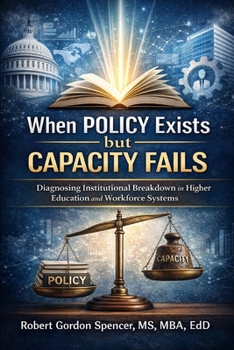
When Policy Exists but Capacity Fails: Diagnosing Institutional Breakdown in Higher Education and Workforce Systems

Why do well-intentioned institutions keep producing the same disappointing results?
Across higher education, workforce systems, and public-sector organizations, leaders respond to underperformance with new policies, clearer procedures, and stronger oversight. Yet outcomes remain uneven-especially for adult learners, veterans, and experienced professionals navigating systems built for linear pathways.
In When Policy Exists but Capacity Fails, Robert Gordon Spencer argues that the problem is not commitment, competence, or effort. It is design.
Institutions increasingly mistake compliance for capacity. Policies articulate what should happen, but systems are not built to support what those policies demand. As rules multiply, judgment narrows, trust is displaced onto procedures, experience is discounted, and decision-making becomes opaque. The result is reform without resolution.
Drawing on research across higher education, public administration, and organizational theory, this book introduces a clear diagnostic framework for understanding institutional breakdown. Key concepts include institutional trust load, academic pathway coherence, discretion demand, and the use of veterans and adult learners as stress tests that reveal system strain long before metrics detect failure.
This book is not a critique of bad actors or flawed intentions. It is a guide for leaders, policymakers, and practitioners seeking to understand why good institutions struggle-and how they can redesign systems to restore judgment, capacity, and legitimacy.
Written in accessible, analytic prose, When Policy Exists but Capacity Fails is intended for:
Higher education leaders and administrators
Workforce and public-sector professionals
Policymakers and governance boards
Scholars and practitioners concerned with institutional design
This is not a call for less accountability.
It is a call for better institutional judgment.
Customer Reviews
ThriftBooks ® and the ThriftBooks ® logo are registered trademarks of Thrift Books Global, LLC
