


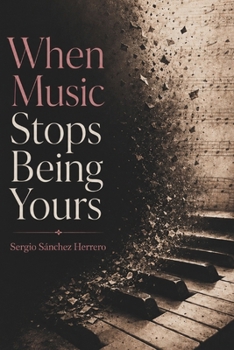
When music stops being yours

You can devote half your life to music and one day discover that you no longer know whether you still love it.
Why do some children learn at an early age that playing well can change the way adults look at them? How can an extraordinary teacher transform a life - and how can a relationship built on fear leave scars that last for years? Why do so many musicians struggle with perfectionism, performance anxiety and the fear of making mistakes?
What happens when someone who once dreamed of becoming a performer spends decades teaching music and barely plays for themselves anymore? Can you become tired of listening to music? Why do melodies sometimes keep playing inside our heads when all we want is silence? Can musical pleasure disappear? And who are we when music has become such a central part of our identity that stepping away from it feels like losing part of ourselves?
When Music Stops Being Yours explores a side of musical life that rarely appears in conservatoires, biographies of celebrated performers or traditional narratives about talent and success.
Blending narrative nonfiction, accessible research and documentary investigation, the book follows the relationship between music and identity from childhood into adult life. It draws on international scientific research, doctoral dissertations, studies in music psychology and education, published interviews, and the experiences of students, teachers, amateur musicians, working professionals and internationally renowned performers.
Across its pages, the book examines family expectations, talent, conservatoire culture, teacher authority, normalised humiliation, perfectionism, performance anxiety, professional insecurity, the identity of the music teacher, burnout, injury, bodily change, pregnancy and menopause, ageing, involuntary musical imagery, earworms, musical anhedonia and the strange form of grief that can begin when someone no longer recognises themselves as a musician.
But this is not a book against music, conservatoires or ambition.
It is a book about the difference between loving something and feeling that you must constantly prove that you deserve it.
It is also about remarkable teachers, families who know how to support without taking ownership of a child's talent, musicians who discover new ways of continuing, and people who realise that they do not need to return at all.
Leaving a musical career does not always mean failure.
Teaching does not mean giving up.
Being an amateur does not mean being an incomplete musician.
And closing the piano does not necessarily mean the story is over.
A book for musicians, students, teachers, families, and anyone who has ever turned a passion into such a large part of their identity that they could no longer tell where one ended and the other began.
Customer Reviews
ThriftBooks ® and the ThriftBooks ® logo are registered trademarks of Thrift Books Global, LLC
