


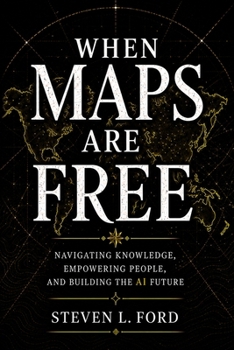
When Maps Are Free: Navigating Knowledge, Empowering People, and Building the AI Future

For centuries, knowledge was power.
The lawyer who knew the law.
The engineer who understood the system.
The executive who possessed the information.
The advisor who could access answers others could not.
But what happens when everyone has the map?
Artificial intelligence is rapidly dismantling one of the oldest assumptions in professional life: that access to information creates value. Today, answers that once required years of training, specialized databases, and professional expertise can appear in seconds.
Yet something unexpected is happening. As information becomes abundant, judgment becomes scarce. As answers become cheaper, wisdom becomes more valuable. As maps become free, navigation becomes priceless.
Through the story of Daniel Whitaker-a respected Gulf Coast attorney navigating a profession being reshaped by artificial intelligence-When Maps Are Free explores one of the most important questions of our time:
What remains valuable when knowledge is no longer difficult to obtain?
Set against complex legal disputes, changing client expectations, emerging technologies, and the quiet realities of family, leadership, and professional responsibility, Daniel begins to discover that the future does not belong to those who simply possess information. It belongs to those who can interpret it, challenge it, contextualize it, and guide others through uncertainty.
Part novel, part professional reflection, and part exploration of the human side of technological change, this book offers a thoughtful and compelling look at a world where artificial intelligence is transforming nearly every profession.
This is not a book about resisting technology. It is a book about understanding what technology cannot replace.
At the center of the story is the Harbor Project, a high-profile construction dispute that initially appears to be a routine legal matter. As the case unfolds, Daniel finds himself navigating conflicting expert opinions, shifting client expectations, emerging technologies, and a younger generation of professionals who have grown up with instant access to information.
Along the way, he begins to recognize a deeper truth: the most important decisions are rarely limited by a lack of answers. They are limited by a lack of judgment.
As Daniel mentors young attorneys, wrestles with difficult strategic decisions, and attempts to guide clients through uncertainty, he discovers that technology is not replacing professional value-it is revealing where that value truly resides.
The questions raised throughout the story extend far beyond law.
What happens to expertise when information becomes abundant?How do leaders build trust in a world overflowing with answers?
What skills should young professionals develop when knowledge is no longer scarce?
And what does it mean to navigate wisely when the map is available to everyone?
Whether you are a lawyer, executive, entrepreneur, engineer, consultant, educator, manager, or simply someone trying to understand where the future is heading, When Maps Are Free provides a powerful framework for thinking about work, leadership, expertise, and human value in the age of artificial intelligence.
The question is no longer whether everyone will have access to the map.
The question is who will know how to navigate.
Customer Reviews
ThriftBooks ® and the ThriftBooks ® logo are registered trademarks of Thrift Books Global, LLC
