


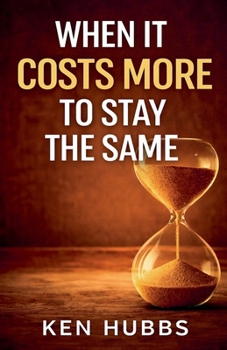
When It Costs More To Stay The Same

When It Costs More to Stay the Same is not a book about change.
It is a book about discernment.
Most people assume staying the same is neutral until something clearly demands action. But in practice, staying the same accumulates cost long before it looks like a problem. That cost rarely appears as failure or crisis. More often, it shows up as added effort, diminished responsiveness, narrowed imagination, or an increasing need to justify continuity. Because nothing breaks, nothing demands attention-and what began as a choice quietly becomes a default.
This book explores that pattern across multiple domains of life: work, money, relationships, belonging, identity, and perception itself. In each case, stability is gained early, cost is deferred, and recognition is delayed. What still functions can nonetheless become expensive to sustain. What still feels faithful can grow burdensome. What once felt chosen can begin to feel inevitable.
Rather than offering steps, strategies, or prescriptions, When It Costs More to Stay the Same develops a different skill: the ability to recognize when neutrality has been lost. It examines how accumulated continuity reshapes judgment, narrows inquiry, and eventually distorts perception-often not through ignorance or fear, but through success, responsibility, and coherence that have grown heavy over time.
At its core, this is a book about learning to read cost accurately when clarity is incomplete and outcomes remain uncertain. It does not argue that change is preferable to stability, nor that endurance is a mistake. Many things are worth sustaining. The question explored here is more precise: What is it costing now to remain where you are?
Written for readers who find themselves "stuck" without having failed, this book restores orientation rather than urgency. It does not tell you what to do. It helps you see where you are, what is being sustained, and what price continuity is now exacting-so that staying, changing, waiting, or enduring can be owned rather than inherited.
Customer Reviews
ThriftBooks® and the ThriftBooks® logo are registered trademarks of Thrift Books Global, LLC
