


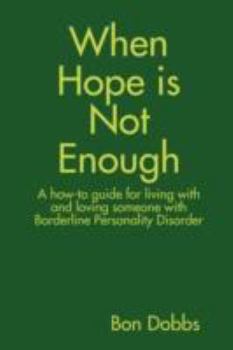
When Hope Is Not Enough: A How-to-guide for Living With and Loving Someone With Borderline Personality Disorder

Select Format
Select Condition 
Book Overview
Does someone you love have Borderline Personality Disorder? Are you in a relationship with a difficult person? Does this person rage at you for no reason at all? Is everything always YOUR fault? Do... This description may be from another edition of this product.
Format:Paperback
Language:English
ISBN:1435719190
ISBN13:9781435719194
Release Date:May 2008
Publisher:Lulu.Com
Length:181 Pages
Weight:0.66 lbs.
Dimensions:8.8" x 0.5" x 5.8"
Customer Reviews
5 ratings
Beyond Hope, into successful living
Published by Thriftbooks.com User , 16 years ago
I am a mental health clinician. I am also the parent of a young person with Borderline Personality Disorder, as it is currently termed. For both these reasons, I have been reading all the literature I could find on this condition for some 20 years. Understanding of BPD has evolved considerably since I first began to try to help my own child: at that time, BPD was attributed to the mother who, according to theorists, was also Borderline or had failed in providing the nurturing necessary to the BPD as an infant and child. In the years since, some more reasonable and helpful literature has emerged, such as the classic "I Hate You, Don't Leave Me," which took BPD out of the mother-blaming culture of the neo-Freudian era and into a more cautious and scientistic redefinition of this problem, Currently, the trend is toward "Dialectic Behavior Therapy" (DBT), which seeks to provide tools for helping the BPD that are more practical and effective than the mother-blaming, boundary-setting techniques which were urged on parents and significant others of BPDs, most of whom felt even more like failures when these tools failed completely. Current thinking acknowledges that BPD could result from any or all of the theories out there, whether from genetics, learned behavior, PTSD or abuse issues of various kinds. Like addiction, no firm conclusions are possible, and treatment has historically been extremely difficult. In fact, the stigma around BPD is such that it has generally been considered untreatable, and many clinicians are averse to even attempting to treat BPD, which currently is classified among "personality disorders," rather than "mood disorders," in the DSM (the "Diagnostic and Statistical Manual" of the American Psychiatric Association, the preferred tool among clinicians for diagnosis, treatment--and payment by the insurance companies)--an important distinction, given that a personality disorder is considered to be an enduring and near-untreatable condition. Classically, the clinician who is presented with a client with BPD tends to privately groan and take an extremely negative view of treatment. In recent years, the book "Stop Walking on Eggshells" was published to great acclaim. Many seemed to feel that it was the first true advancement in diagnosis, understanding and treatment, but I found it to be far too elementary in its analysis, with little of true value where treatment is concerned. It focuses more on validating the anger and resentment of the "non," the person who is, in theory, "normal" and lives with a BPD. In truth, I am puzzled at its success, which I can only attribute to the desperate need of "nons" for help. Enter Bon Dobbs' book and his revolutionary view of BPD and living with someone who has BPD. It is the first book of its kind that reinforces the reality that a person who HAS BPD is not the condition, but a person with rights and needs like any other. Dobbs' book focuses on the understanding of the disorder,
Hope might not be enough, but this book helped me hang onto what little bit I had left.
Published by Thriftbooks.com User , 17 years ago
In Oct 2007, I was at my wits end and ready to walk away from my raging husband after 4 months of marriage. He had been in therapy for over a year, yet still raging almost daily, beating himself half to death, lying to me about the most ridiculous stuff and destroying our home. All this chaos was causing my 2 teenagers to alienate me out of fear of him. As a Project Manager, I had participated in many classes and seminars on effective communication in the workplace through my job, but it seemed that nothing I tried worked with my husband... most of the time, it only seemed to make things worse. I truly felt helpless. I knew I loved him and I fully understood the complexity of this disorder and how my own (natural) reactions to his behavior contributed to the dynamics of our relationship, but I also realized I didn't have what it took to provide the healthy and supportive home environment I knew he needed in order to heal from his past. At the urging of my own therapist (whom I had retained for my own sanity), I decided to join an online support group for loved ones of people who suffered from Borderline Personality Disorder. I found a group called Anything To Stop The Pain (ATSTP). As time went by (with me lurking in the group), I realized that the founder of the group (Ben Dobbs, the author of this book) was promoting a very similar approach with group members that my husband's therapist was using with him during their sessions. I got more involved with the group and learned how to use this approach, at home, with my husband (and, consequently, with other family members also.) Ten months later, I'm happy to say that my husband's raging has reduced to, maybe, once every few months and the intensity is nothing like before --- despite the fact that he hasn't been attending therapy on as regular a basis as I had understood was necessary for improving his emotional health. We are finally enjoying the closeness we both wanted in our marriage. My house feels and looks like a home again (rather than a battlefield) and my kids are back to spending more time with us again. He is slowly changing his maladaptive coping methods to more healthy ones... and working out his past by using this same approach with his own family. It feels good to get genuine apologies (versus "FINE! IT'S ALL MY FAULT!!") and 'thank you's' (versus daily blaming and projecting) for my patience and understanding. I have read many books on this disorder. I found 'Stop Walking on Eggshells' to be quite validating to my feelings as a loved one (a NON) to a borderline. In that sense, it was very healing for me, personally, but it didn't help me improve my relationship. 'I Hate You, Don't Leave Me', 'Sometimes I Act Crazy' and 'Get Me Out of Here' were beneficial to me in that they helped remind me that my husband's erratic behaviors really were not about me at all. From my personal experience, this book is the next progressive step for those who recognize that they cannot FIX their bo
Essential reading for anyone with a BPD loved one
Published by Thriftbooks.com User , 17 years ago
I just realized that I read this book only 18 days ago--and already I feel like my relationship with my wife is transforming! I too read this book in a single day, and I can't say enough good things about it. WHINE is helping me to save both my marriage and my own mental health, and in the process it is helping me help my wife without losing myself in the process. When I first suspected my wife had BPD, I came across "Stop Walking on Eggshells" (SWOE), which my therapist recommended, and which helped me understand how my life had been affected after a year of living with my wife. But I also wanted to understand what my wife was going through and to learn to better interact with her, and I found SWOE to be unsatisfactory and incomplete in this respect. "When Hope is Not Enough" (WHINE) was the answer. It lays out a clear explanation of BPD and a step-by-step skills development plan for improving interactions with my wife. Thanks to this book and the other resources it suggests, I no longer live in a fog of confusion and despair, and I am optimistic for the future of our family. Interactions are still sometimes very difficult with my wife, but I better understand why now, and I'm learning how to make them better every day. Thank you, Bon, for writing WHINE.
Best book for BP supporters EVER!
Published by Thriftbooks.com User , 17 years ago
This book is a spectacular collection of effective techniques for dealing with the enormous challenges faced by those who are in a relationship with BPD. Other books offer valuable explanations and assist in understanding this complex condition, this book goes beyond that and offers practical, daily, step-by-step actions that non-BP's can take to effectively assist and support their BP, in a way that reduces conflict and maximizes cooperative working with a loved one who has this painful condition. With examples of typical BP conversations...where they could go...and where you can take them instead... this book offers an actual roadmap to greater success. While a BP's healing is ultimately up to them, this book shows ways that "non-BP's" can help themselves and their loved one, both before that decision is made, and during their choice for healing, and minimize the conflict and pain involved for everyone during those interactions. For those of us who care about someone with BPD, this book is MOST HIGHLY RECOMMENDED!!!!
A Real How-To!
Published by Thriftbooks.com User , 17 years ago
I bought this book and read it cover-to-cover in a single day. This is the first book for non-bps that I have ever read (and I've read a few, including "One way ticket to Kansas", "Stop Walking on Eggshells", and "Tears and Healing") that actually tells you what to do and say and how to do and say it. By applying the tools from this book, I was able to have a much less chaotic relationship with my BPD wife. Wow! If I could, I'd give it 10 stars! I wish this book had been available 10 years ago.
Copyright © 2026 Thriftbooks.com Terms of Use
| Privacy Policy | Do Not
Sell/Share My Personal Information | Cookie Policy | Cookie Preferences | Accessibility Statement
ThriftBooks® and the ThriftBooks® logo are registered trademarks of Thrift Books Global, LLC
ThriftBooks® and the ThriftBooks® logo are registered trademarks of Thrift Books Global, LLC
