


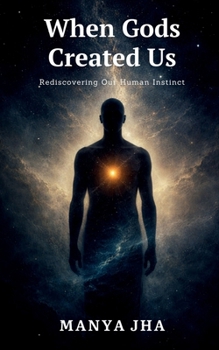
When Gods Created Us: Rediscovering Our Human Instinct

Select Format
Select Condition 
Book Overview
When Gods Created Us is a mythological-philosophical exploration of what humanity once carried within itself and what it gradually forgot. Through the recurring presence of a cosmic council, the book traces the evolution of human consciousness from its earliest design to the rise of modern civilization. It explores how awareness, instinct, emotion, imagination, compassion, courage, and purpose once shaped humanity before systems, performance, and measurable intelligence began defining human worth.
Rather than treating myth as fantasy or technology as an enemy, the book examines what remains uniquely human in the age of artificial intelligence. As machines increasingly learn to calculate, predict, and optimize, humanity is forced to confront a deeper question: if intelligence can be replicated, then what truly defines being human? The book argues that consciousness extends beyond reason, and that humanity's deepest capacities may lie in its ability to feel, question, imagine, and morally hold the world around it.
At its core, When Gods Created Us argues that human beings were never designed merely to survive, compete, or outperform their own creations. They were designed to awaken to the full structure of the mind they carry. The book ultimately asks whether civilization can still be guided by awareness, compassion, wisdom, and meaning before the systems humanity created cause it to forget itself completely.
Customer Reviews
ThriftBooks ® and the ThriftBooks ® logo are registered trademarks of Thrift Books Global, LLC
