


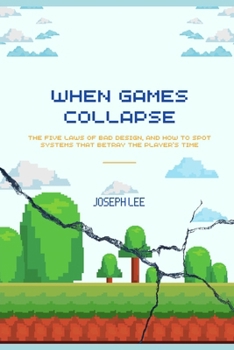
When Games Collapse: The Five Laws of Bad Design, and How to Spot Systems That Betray the Player's Time

Every gamer knows the feeling: a promising game turns sour.
A world that looks alive reveals its emptiness.
A system meant to engage becomes a chore.
Moments that should feel meaningful dissolve into repetition, frustration, or confusion.
But why does this happen?
"Gamer's Eye - Part I: When Games Collapse" is a full-scale investigation into the anatomy of failure in game design. Rather than ranting or reviewing, the author approaches each title as a complex system-one that either supports or suffocates the player experience.
Through deep analysis of five well-known games that falter in critical ways, this book uncovers the invisible mechanisms behind collapse:
how reward loops break
how forced playtime destroys motivation
how systems compete instead of integrate
how world logic fails and immersion dies
how artificial inconvenience masquerades as "depth"
how monetization strategies compromise design
how pretension replaces genuine meaning
Each case study-Baby Steps, The Hunters, Forager, My Time at Portia, and Portal Knights-is examined with care and precision. The goal is not to insult developers, but to reveal the structural decisions that lead to exhaustion, disappointment, and player dropout.
Failure, when analyzed correctly, becomes the clearest teacher.
And that is the heart of this book:
games collapse for reasons-technical, psychological, narrative, mechanical-and once you understand them, you can never unsee the patterns.
Part I stands as a complete volume, dedicated entirely to the architecture of bad design. It exposes the fault lines that run through broken worlds and explains why players instinctively feel when something is "off," even if they cannot articulate it.
Part II, released separately, examines the opposite phenomenon: how masterpieces like Baldur's Gate 3, Elden Ring, and Valheim succeed by honoring the player's time and embedding meaning into every system.
Whether you are a gamer who wants to understand your own instincts, a designer searching for clarity, or a writer exploring interactive storytelling, this book offers a powerful lens:
games cannot lie. Their systems reveal everything.
Customer Reviews
ThriftBooks® and the ThriftBooks® logo are registered trademarks of Thrift Books Global, LLC
