


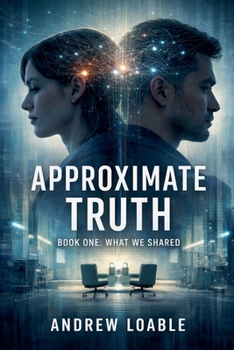
What We Shared

Approximate Truth: What We Shared
In a near future where trust is a data point and refusal is a confession, Isabel and Jian are the perfect couple. To prove it to their families, their employers, and the state, they agree to a pre-marital brain sync. The clinic reports a flawless 96 percent coherence score, a number that guarantees stability, secures their mortgage, and validates their love.
But the machine does not reveal truth; it produces confidence.
As the sync ends, the boundaries of their identities fail to reset. Isabel begins to inherit Jian's structural sadness, a visceral grief for a childhood she never lived. Jian absorbs her high-resolution anxiety, finding himself stabilized by a calm he did not earn. What the doctors call signal ringing, Isabel experiences as a haunting. The foundation of their life is not a shared heart, but a shared error.
When the relationship fractures under the weight of this borrowed noise, the data becomes a weapon. In the cold theater of a Relational Dissolution hearing, Isabel discovers that their perfect score was a lie, a clinical fraud manufactured to meet a quota. Now, she must decide if she will release her raw neural telemetry to win her freedom, or if she will choose the dignity of the unknown. In a world that demands total transparency, her final act of love will be the restoration of the private mind.
Customer Reviews
ThriftBooks ® and the ThriftBooks ® logo are registered trademarks of Thrift Books Global, LLC
