


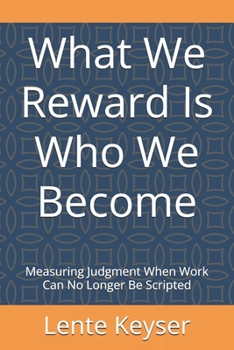
What We Reward Is Who We Become: Measuring Judgment When Work Can No Longer Be Scripted

Most modern work can no longer be scripted.
Yet most organisations still measure performance as if it can.
As systems become more sophisticated and AI increasingly supports decision-making, responsibility does not disappear. It shifts. Quietly. Often invisibly. And the metrics used to govern work frequently reward certainty, speed, and compliance even when the work itself demands judgment.
What We Reward Is Who We Become explores how measurement shapes behaviour, thinking, and responsibility in environments where decisions cannot be reduced to rules or checklists. It examines how well-intentioned scorecards suppress discretion, how calibration turns into theatre, and how organisations unintentionally train people to optimise for what is easy to count rather than what actually matters.
This is not a book about rejecting technology or automation. It is about designing systems that strengthen judgment instead of eroding it.
Written for people working inside complex, real-world organisations, the book offers a clear, practical lens on how to recognise good reasoning, reward coherent decision-making, and build systems that learn rather than simply enforce.
Whether you design metrics, manage performance, build AI-supported workflows, or live inside them, this book invites a deeper question:
What kind of organisation are your rewards quietly creating?
What you will find in this book
Why judgment does not disappear in AI-augmented systems, but relocates
How metrics silently train behaviour long before culture statements do
Why calibration often fails, and what it takes to make it meaningful
How organisations suppress good judgment without intending to
Practical ways to design measurement for work that cannot be fully scripted
Guardrails that protect responsibility, learning, and escalation at scale
Who this book is for
Leaders responsible for performance, quality, or governance
Practitioners working in operations, service, policy, risk, or escalation roles
Anyone designing or working inside AI-supported decision systems
Readers interested in the future of work beyond slogans and frameworks
It is especially relevant for organisations navigating complexity, uncertainty, and trade-offs where the "right answer" is rarely obvious.
Customer Reviews
ThriftBooks ® and the ThriftBooks ® logo are registered trademarks of Thrift Books Global, LLC
