


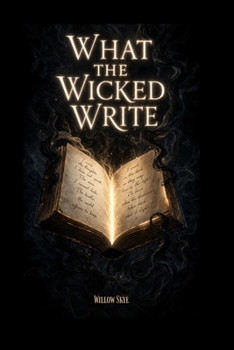
What the Wicked Write

He killed four people. He wrote the most beautiful poetry anyone had ever read. And in seven days, the state will execute him.
On a Tuesday in October, a photograph of a handwritten poem goes viral.
By Wednesday morning, The Cartography of Ruin - a poetry collection by Solomon Vane, convicted murderer and death row inmate - is the number one bestselling book in the country. The first print run of eight hundred copies sells out in forty minutes. Four thousand letters arrive at the publisher's office. And the nation finds itself facing a question it does not know how to answer:
What do you do when something terrible and something beautiful come from the same place?
Told across two timelines - the seven days before Solomon Vane's scheduled execution and the years that brought him there - What the Wicked Write moves between the present and the past with the precision of a scalpel. We meet Eloise Marsh, the deputy warden who has spent nine years watching Solomon Vane write without once asking what he was writing. Maggie Doyle, twenty-six years old, whose mother was his first victim, who drives two hours twice because she needs to look at him before it is over. Marcus Webb, the Brooklyn publisher who printed eight hundred copies of a dead man's poems and woke up famous. Detective Adrienne Park, who spent three years connecting the crimes and cannot put the collection down. And Carolyn Byrd, the defense attorney who received a poem after the verdict and has never shown it to anyone.
At the center of all of them: Solomon Vane. A man who taught high school English for fourteen years. A man who killed four people over eight years. A man who, in eleven years on death row, wrote thirty poems that may be the most honest things any of them have ever read.
What the Wicked Write does not ask you to forgive him.
It asks you to hold two true things at the same time - the beauty and the ruin, the poem and the crime, the man and what he made - and to sit with the discomfort of not being able to put either one down.
For readers of Colm T ib n, Donna Tartt, and Paul Tremblay. For anyone who has ever been moved by something they weren't supposed to feel.
Customer Reviews
ThriftBooks ® and the ThriftBooks ® logo are registered trademarks of Thrift Books Global, LLC
