


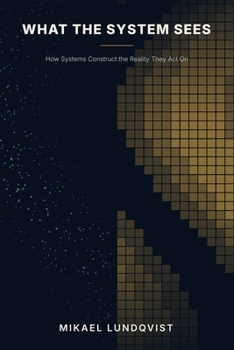
What the System Sees: How Systems Construct the Reality They Act On
No Customer Reviews

Every system that makes decisions about people first has to decide what it can see. What the System Sees argues that this is where the decisive step happens. Before a system measures, rates, diagnoses or assesses anyone, reality has already been reduced to something that can be represented. The decisions that follow are made in that representation, not in the world it stands for. But the story does not end with the decision. Decisions act on reality, and what comes back is read through the same model that helped produce it. What fits is confirmed and reinforced; what does not is reinterpreted, weakened or lost. Repeated over time, this hardens into structure. The system does not merely describe the reality it acts on. It helps construct it. Beginning with information theory and the necessity of models, the book builds one continuous argument: how uncertainty becomes structure, how structure meets individuals, how processes reinforce themselves, and why a system's stability can be an effect of its own reproduction rather than proof that it is right. Systems need no intentions to do this. It is enough that they function. A general theory for anyone who works inside systems, is judged by them, or wants to understand why well-meant decisions so often miss the person they concern.
Format:Paperback
Language:English
ISBN:B0HN7DL4Y9
ISBN13:9798162533696
Release Date:October 2026
Publisher:Independently Published
Length:142 Pages
Weight:0.44 lbs.
Dimensions:0.3" x 6.0" x 9.0"
Customer Reviews
0 rating
Copyright © 2026 Thriftbooks.com
Terms of Use | Privacy Policy | Do Not Sell/Share My Personal Information | Cookie Notice | Cookie Preferences | Accessibility Statement
ThriftBooks ® and the ThriftBooks ® logo are registered trademarks of Thrift Books Global, LLC
ThriftBooks ® and the ThriftBooks ® logo are registered trademarks of Thrift Books Global, LLC
