


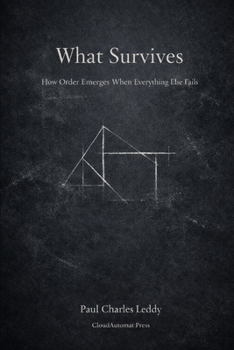
What Survives: How Order Emerges When Everything Else Fails

Why does anything in the universe persist at all?
Why do laws exist, rather than chaos?
Why does structure emerge in physics, life, and thought, when most possibilities collapse?
This book offers a single, unifying answer:
What survives does so not because it is optimal, chosen, or inevitable - but because it does not break.
Drawing on modern physics, climate science, complex systems, and the renormalization group, What Survives reframes the foundations of explanation itself. Laws are not imposed on reality; they are the residue left after inconsistency is eliminated. Order is not designed; it is what remains when instability has exhausted itself.
Written in clear, non-technical language, this book avoids speculation, mysticism, and grand claims. It does not replace existing physics. It reorganizes how we understand why stable structure appears at all.
The second half of the book extends this framework across scales - from molecules and materials to learning systems, intelligence, and culture - and concludes with a case study of the 2021 Nobel Prize in Physics, showing how persistence-first reasoning already underlies some of the most careful science of our time.
This is not a theory of everything.
It is a theory of what can remain.
Customer Reviews
ThriftBooks ® and the ThriftBooks ® logo are registered trademarks of Thrift Books Global, LLC
