


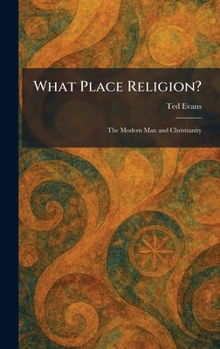
What Place Religion?: The Modern Man and Christianity

"What Place Religion? Or, the Modern Man and Christianity" is a compelling examination of the role of faith within the rapidly shifting landscape of the early 20th century. Written by Ted Evans, the work addresses the growing tension between traditional Christian doctrines and the emerging intellectual and social pressures of modern life. As scientific progress and secularism began to challenge established religious norms, Evans explores whether Christianity could maintain its relevance for the contemporary individual.
The book delves into the heart of the modernist era, questioning how religious experience can be reconciled with a world increasingly defined by materialism and skeptical inquiry. Evans provides a thoughtful analysis of the spiritual needs of the "modern man," seeking a middle ground where faith is neither abandoned nor held in blind adherence to the past. By addressing themes of morality, social responsibility, and the nature of belief, the text serves as a significant historical artifact of religious apologetics during a period of profound cultural transition.
Ideal for students of theology, history, and philosophy, "What Place Religion? Or, the Modern Man and Christianity" offers a window into the anxieties and hopes of a generation striving to find a meaningful place for the divine in an age of reason.
This work has been selected by scholars as being culturally important, and is part of the knowledge base of civilization as we know it. This work was reproduced from the original artifact, and remains as true to the original work as possible. Therefore, you may see the original copyright references, library stamps (as most of these works have been housed in our most important libraries around the world), and other notations in the work.
This work is in the public domain in the United States of America, and possibly other nations. Within the United States, you may freely copy and distribute this work, as no entity (individual or corporate) has a copyright on the body of the work.
As a reproduction of a historical artifact, this work may contain missing or blurred pages, poor pictures, errant marks, etc. Scholars believe, and we concur, that this work is important enough to be preserved, reproduced, and made generally available to the public. We appreciate your support of the preservation process, and thank you for being an important part of keeping this knowledge alive and relevant.
Customer Reviews
ThriftBooks ® and the ThriftBooks ® logo are registered trademarks of Thrift Books Global, LLC
