


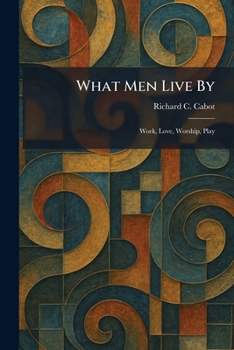
What Men Live By: Work, Love, Worship, Play

"What Men Live By" is a profound exploration of the four essential pillars that support a healthy and fulfilling human life: work, love, worship, and play. Written by physician and social ethics professor Richard C. Cabot, this influential work examines how these four elements provide the necessary structure for individual happiness and moral well-being.
Cabot argues that a balanced existence requires the integration of productive labor, meaningful relationships, spiritual devotion, and restorative recreation. He provides a roadmap for navigating the complexities of modern existence by reconnecting with these fundamental human needs. The book serves as both a philosophical treatise and a practical guide for those seeking to achieve a more harmonious life.
By treating the soul and body as an interconnected whole, "What Men Live By" remains a significant contribution to the fields of ethics and self-improvement. Its timeless insights into the pursuit of purpose and the cultivation of character continue to inspire readers looking for a deeper understanding of what it means to live well.
This work has been selected by scholars as being culturally important, and is part of the knowledge base of civilization as we know it. This work was reproduced from the original artifact, and remains as true to the original work as possible. Therefore, you may see the original copyright references, library stamps (as most of these works have been housed in our most important libraries around the world), and other notations in the work.
This work is in the public domain in the United States of America, and possibly other nations. Within the United States, you may freely copy and distribute this work, as no entity (individual or corporate) has a copyright on the body of the work.
As a reproduction of a historical artifact, this work may contain missing or blurred pages, poor pictures, errant marks, etc. Scholars believe, and we concur, that this work is important enough to be preserved, reproduced, and made generally available to the public. We appreciate your support of the preservation process, and thank you for being an important part of keeping this knowledge alive and relevant.
Related Subjects
Philosophy Religion Religion & Spirituality Self Help Self-Help Self-Help & PsychologyCustomer Reviews
ThriftBooks ® and the ThriftBooks ® logo are registered trademarks of Thrift Books Global, LLC
