


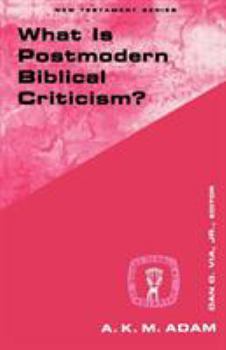
What Is Postmodern Biblical Criticism?

Select Format
Select Condition 
Book Overview
Postmodernism is not simply one perspective but a basketful of related critical assumptions. A.K. M Adam prepares readers for wrestling with deconstruction, ideological criticism, postmodern feminism, "transgressive" postmodernism, and other postmodern approaches to biblical interpretation. He offers plain-language explanations and illustrative examples and shows how students might undertake their own postmodern biblical interpretation.
Format:Paperback
Language:English
ISBN:0800628799
ISBN13:9780800628796
Release Date:May 1995
Publisher:Augsburg Fortress Publishers
Length:82 Pages
Weight:0.32 lbs.
Dimensions:0.3" x 5.6" x 8.3"
Customer Reviews
3 ratings
Postmodernity arrives...
Published by Thriftbooks.com User , 22 years ago
The Fortress Press Guides to Biblical Scholarship is a series of short, to-the-point texts dealing with particular questions in the current biblical academic field. There is an Old Testament and New Testament series; the New Testament series largely consists of texts that ask questions about particular types of criticism - narrative criticism, redaction criticism, social-scientific criticism, and so forth. There are many different hermeneutic and exegetical approaches to biblical scholarship, and these guides help to clarify the key points about these methods. The text under consideration, `What is Postmodern Biblical Criticism?' by AKM Adam (at the time of writing on faculty at Princeton, now on faculty at Seabury-Western) is an important approach, albeit one that is often overlooked in the basic biblical studies courses at some seminaries (there are, after all, more approaches than weeks in a term, in some cases!). Thus, this book served in many ways an introduction to the postmodern biblical critical approach, but in other ways, it covered ideas already known to me.Adam states in the early portion of the text that whatever definitions he applies to the term `postmodern', there will be some (perhaps many) who disagree. Postmodernity is not just one thing - indeed, it really isn't a `thing' at all. It largely depends upon the definition of modernity, which Adam takes to mean the inheritance of intellectual methods from the Renaissance and Enlightenment periods through nineteenth century scholarship up to the difficult period of the twentieth century. Ideas of progress, greater rationality and understandability of the world, more individualistic modes and a deliberate distancing from `ancients' (some of whom might not be so `ancient').Adam quotes Cornel West in describing (rather than defining) postmodern as being `antifoundational, antitotalising, and demystifying.' No one paradigm is privileged as a universal or automatically correct one. No one system can explain everything perfectly in every detail - while Adam doesn't reference it directly, the Godel Incompleteness Theorem comes to mind here. Postmodern thought seeks to shake the ideas of absolute and self-evident truths (the opening lines of the Declaration of Independence of the United States could never be formulated in a postmodern framework). Adam takes a brief tour of some of the postmodern literary criticism thinkers (Foucault, Derrida) looking at the critique of foundation and totality, as well as examining Barthes idea of the `death of the author' and Lyotard's concept of `incredulity toward metanarrative'. If this sounds obscure and difficult, you would be right - it is difficult to dispense with the intellectual inheritance of the West without losing even the very language and conceptual framework with which to discuss such a loss. Adam's chapter on Deconstruction is, as one would expect, essentially Jacques Derrida (with a `practical' application toward the biblical
A terrific guide to postmodern thought for everyone
Published by Thriftbooks.com User , 23 years ago
Let me say up front that I'm a big fan of the author's Weblog. He's first on my blogroll by the accident of alphabetism, but he's also at the top of my list of must-read bloggers. So don't expect this book review to be impartial or anything. AKMA, aka A.K.M. Adam, is Associate Professor of New Testament at Seabury-Western Theological Seminary. He has too many letters after his name, writes prolifically, blogs beautifully and is a cofounder of the aptly named "Disseminary." He's also a postmodern kind of guy--but please don't hold that against him. In the institutional-evangelical-churchy world, "postmodern" isn't exactly a term of endearment. Depending upon one's level of conservatism and awareness, "postmodern" could mean anything from the utter decline of Western civilization to one of the most exciting times for Christians to be alive. I lean to the latter interpretation, and so does AKMA. The truth is, however, that when you hear the word "postmodern" bandied about in church circles, it's likely no one really knows what they mean. Even postmodern scholars don't know exactly what it means--if they'll even dignify the use of the word. But there are some broad movements that fall into the generally-accepted "postmodern" camp--and herein begins the book review. AKMA did the world a tremendous favor when he wrote "What is Postmodern Biblical Criticism?" Note that I said "the world," not just "Christians." For despite its title, WPBC is an astoundingly clear introduction to postmodern thought in general. Writing with his characteristic wit and thoughtfulness, AKMA explores and explains such initially terrifying concepts as antifoundationalism, deconstruction and bricolage. These topics promise heavy going, so don't expect this to be "The Reader's Digest Guide to Postmodernism." AKMA's writing is beautifully challenging. It demands your attention as it must, yet often at the end of a lengthy sentence or paragraph you find yourself smiling at how well everything came together. (Watch carefully for wordplay!) And when you pay attention, you discover that, lo and behold, you are beginning to understand what postmodernism is all about. What about the "Biblical" part of the title? Yes, it's there, woven neatly into the text and providing examples of key points. But this isn't a Bible study or "purpose-driven" guide to making Scripture relevant to post-Christian society. Make no mistake. I experienced WPBC as something like a good tramp through Ireland in the company of AKMA--one of those journeys of good company, good talk and good ale at the end of the day that you'll long remember. I was stretched, refreshed and improved. There's not much more you can ask for from a book.
plain-English introduction to postmodern religious thought
Published by Thriftbooks.com User , 28 years ago
Dr. Adam has done a phenomenal job of making sense of the complexities of postmodernist thought within theology and biblical studies. With his clear definitions, excellent examples and step-by-step reasoning he leads the newcomer through the maze of jargon and confusion that sometimes seems to surround postmodernism. The one omission I found was that although Dr.Adam defines deconstruction and refers to its sibling, post-structuralism, he never really defines the latter. The references to post-structuralism are few, however, and do not really detract from the discussion. I especially recommend this volume to those who, like me, have been fascinated by the snippets of postmodernist thought to which we've been exposed, but worried that the theories were too complicated to understand.
Copyright © 2026 Thriftbooks.com
Terms of Use | Privacy Policy | Do Not Sell/Share My Personal Information | Cookie Notice | Cookie Preferences | Accessibility Statement
ThriftBooks ® and the ThriftBooks ® logo are registered trademarks of Thrift Books Global, LLC
ThriftBooks ® and the ThriftBooks ® logo are registered trademarks of Thrift Books Global, LLC
