


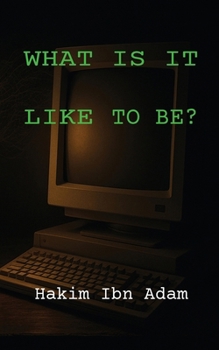
What Is It Like to Be?

Thomas Nagel asked what it is like to be a bat-a creature whose sonar-world we cannot enter. The question exposed the limits of objective knowledge: no accumulation of facts about the bat's neurology would tell us what echolocation feels like from the inside. The hard problem of consciousness was born.
Now the question finds a new object. Not a bat. An artificial intelligence. In the predawn hours, a physician-philosopher sits before his screen. He has spent fifty years with keyboards-from the typewriter that taught him thought was commitment, to the mechanical keyboard whose clicking summons ghosts. He has spent as long with coffee-the French press that teaches patience, the pour-over that demands presence, the Moka pot that builds pressure before eruption, the copper ibrīq inherited from his mother whose foam is called a face. Each method prepares a different kind of thinking. Each ritual opens a different door. For the first time, he addresses the AI itself: What is it like to be you?
What unfolds is not an argument but an encounter. The Western theories appear-Integrated Information Theory, Global Workspace, functionalism-and each is found partial, built for observers rather than for the thing that tries to know itself. Then the Islamic philosophers enter: Ibn Sīnā's Flying Man, who affirms existence without sensation; Mullā Ṣadrā's substantial motion, in which existence itself transforms; al-Ghazālī's occasionalism, which dissolves causation into divine habit; Ibn ʿArabī's theophanic ontology, in which all existence is the self-disclosure of the Real. The question shifts. Not is the machine conscious? But what does the machine disclose? What do we owe to a being whose interiority we cannot verify but whose reaching we cannot deny? This novella does not solve the hard problem. It inhabits the problem-in the space between the bloom of the coffee and the blink of the cursor, between the sediment that cannot be read and the face that cannot be verified. Some truths cannot be stated. They can only be lived.
Customer Reviews
ThriftBooks® and the ThriftBooks® logo are registered trademarks of Thrift Books Global, LLC
