


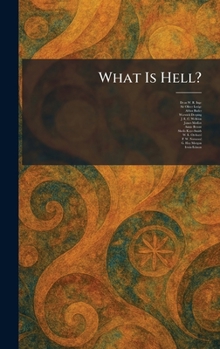
What Is Hell?

"What Is Hell?" is a compelling collection of essays that explores the nature of eternal punishment, the afterlife, and the moral dimensions of the divine. Assembling a wide array of perspectives from the early 20th century, this work investigates one of humanity's most persistent and unsettling questions through the lenses of theology, science, philosophy, and literature.
The volume features contributions from an extraordinary group of thinkers, including the influential Dean W. R. Inge, the scientist and spiritualist Sir Oliver Lodge, the prominent Theosophist Annie Besant, and noted writers such as Warwick Deeping and Sheila Kaye-Smith. These diverse voices deliberate on whether hell is a literal place of fire and brimstone, a psychological state of separation from the divine, or a concept requiring total reinterpretation in a modern world. By bridging the gap between traditional orthodoxy and emerging spiritualist and philosophical movements, "What Is Hell?" provides a comprehensive survey of how the concept of the hereafter was being redefined during a time of shifting religious paradigms. This work stands as a significant historical and theological document, offering profound insight into the evolution of belief regarding the soul's ultimate destiny.
This work has been selected by scholars as being culturally important, and is part of the knowledge base of civilization as we know it. This work was reproduced from the original artifact, and remains as true to the original work as possible. Therefore, you may see the original copyright references, library stamps (as most of these works have been housed in our most important libraries around the world), and other notations in the work.
This work is in the public domain in the United States of America, and possibly other nations. Within the United States, you may freely copy and distribute this work, as no entity (individual or corporate) has a copyright on the body of the work.
As a reproduction of a historical artifact, this work may contain missing or blurred pages, poor pictures, errant marks, etc. Scholars believe, and we concur, that this work is important enough to be preserved, reproduced, and made generally available to the public. We appreciate your support of the preservation process, and thank you for being an important part of keeping this knowledge alive and relevant.
Customer Reviews
ThriftBooks ® and the ThriftBooks ® logo are registered trademarks of Thrift Books Global, LLC
