


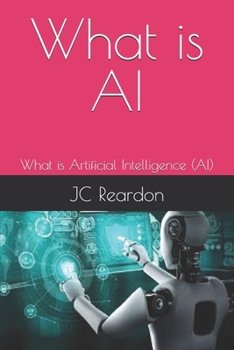
What is AI: What is Artificial Intelligence (AI)
No Customer Reviews

Artificial Intelligence (AI) is a broad field of computer science focused on building systems or machines that can perform tasks that would typically require human intelligence. These tasks include reasoning, learning, problem-solving, perception, language understanding, and decision-making. AI systems are often designed to simulate human-like cognition or augment human abilities in various domains.
Here are some key areas and concepts within AI:
1. Types of AI
AI is often categorized based on its capabilities and functionality: Narrow AI (Weak AI):
This is AI designed and trained for a specific task, such as image recognition, language translation, or playing chess. Narrow AI is the most common form in use today.General AI (Strong AI):
This refers to AI that can perform any intellectual task that a human can do. It has the ability to understand, learn, and apply knowledge across a wide range of tasks. General AI is still largely theoretical and is a goal for the future.Superintelligent AI:
This is a hypothetical AI that surpasses human intelligence across all fields. It could potentially outperform humans in every task, from creative work to scientific research.2. Subfields of AIMachine Learning (ML):
A subset of AI that enables machines to learn from data and improve over time without being explicitly programmed. Machine learning involves algorithms that find patterns in data and use these patterns to make predictions or decisions. It includes: Supervised learning: The model is trained on labeled data (input-output pairs).Unsupervised learning: The model identifies patterns in data without labels.Reinforcement learning: The model learns by interacting with an environment and receiving feedback (rewards or penalties).Natural Language Processing (NLP):
This is the branch of AI focused on enabling machines to understand, interpret, and respond to human language. It includes tasks like translation, sentiment analysis, chatbots, and speech recognition.Computer Vision:
AI techniques that allow machines to interpret and make decisions based on visual data (images or videos). It's used in facial recognition, object detection, autonomous vehicles, and medical imaging.Robotics:
Combines AI with mechanical engineering to create robots that can interact with the physical world. AI-powered robots can perform tasks autonomously, such as in manufacturing or healthcare.Expert Systems:
These are AI systems designed to mimic the decision-making ability of a human expert in a specific field. They use predefined rules and knowledge bases to make decisions.3. Key Technologies in AIDeep Learning:
A subset of machine learning, deep learning uses artificial neural networks with many layers (hence "deep") to process complex patterns in large amounts of data. Deep learning is behind many breakthroughs in fields like image and speech recognition.Neural Networks:
These are computational models inspired by the human brain. They consist of layers of interconnected "neurons" that process information and learn patterns through training.Generative Models:
These models, such as GANs (Generative Adversarial Networks), can generate new data that mimics real-world data. They are used in image generation, style transfer, and text creation.
Here are some key areas and concepts within AI:
1. Types of AI
AI is often categorized based on its capabilities and functionality: Narrow AI (Weak AI):
This is AI designed and trained for a specific task, such as image recognition, language translation, or playing chess. Narrow AI is the most common form in use today.General AI (Strong AI):
This refers to AI that can perform any intellectual task that a human can do. It has the ability to understand, learn, and apply knowledge across a wide range of tasks. General AI is still largely theoretical and is a goal for the future.Superintelligent AI:
This is a hypothetical AI that surpasses human intelligence across all fields. It could potentially outperform humans in every task, from creative work to scientific research.2. Subfields of AIMachine Learning (ML):
A subset of AI that enables machines to learn from data and improve over time without being explicitly programmed. Machine learning involves algorithms that find patterns in data and use these patterns to make predictions or decisions. It includes: Supervised learning: The model is trained on labeled data (input-output pairs).Unsupervised learning: The model identifies patterns in data without labels.Reinforcement learning: The model learns by interacting with an environment and receiving feedback (rewards or penalties).Natural Language Processing (NLP):
This is the branch of AI focused on enabling machines to understand, interpret, and respond to human language. It includes tasks like translation, sentiment analysis, chatbots, and speech recognition.Computer Vision:
AI techniques that allow machines to interpret and make decisions based on visual data (images or videos). It's used in facial recognition, object detection, autonomous vehicles, and medical imaging.Robotics:
Combines AI with mechanical engineering to create robots that can interact with the physical world. AI-powered robots can perform tasks autonomously, such as in manufacturing or healthcare.Expert Systems:
These are AI systems designed to mimic the decision-making ability of a human expert in a specific field. They use predefined rules and knowledge bases to make decisions.3. Key Technologies in AIDeep Learning:
A subset of machine learning, deep learning uses artificial neural networks with many layers (hence "deep") to process complex patterns in large amounts of data. Deep learning is behind many breakthroughs in fields like image and speech recognition.Neural Networks:
These are computational models inspired by the human brain. They consist of layers of interconnected "neurons" that process information and learn patterns through training.Generative Models:
These models, such as GANs (Generative Adversarial Networks), can generate new data that mimics real-world data. They are used in image generation, style transfer, and text creation.
Format:Paperback
Language:English
ISBN:B0F2DH4Z2H
ISBN13:9798315336389
Release Date:March 2025
Publisher:Independently Published
Length:288 Pages
Weight:0.85 lbs.
Dimensions:0.6" x 6.0" x 9.0"
Customer Reviews
0 rating
Copyright © 2026 Thriftbooks.com
Terms of Use | Privacy Policy | Do Not Sell/Share My Personal Information | Cookie Notice | Cookie Preferences | Accessibility Statement
ThriftBooks ® and the ThriftBooks ® logo are registered trademarks of Thrift Books Global, LLC
ThriftBooks ® and the ThriftBooks ® logo are registered trademarks of Thrift Books Global, LLC
