


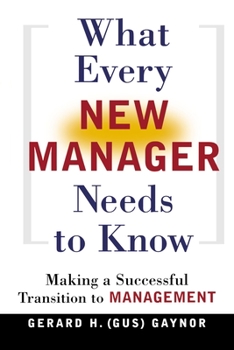
What Every New Manager Needs to Know: Making a Successful Transition to Management


"Companies depend on the ability of managers to fulfill organizational vision and meet crucial objectives. But without a firm grasp of critical management competencies, new managers' own futures -- as well as the company's -- can be at serious risk. What Every New Manager Needs to Know gives readers the skills they need to excel in their new responsibilities, such as managing the relationship between individual and team performance, making key people decisions like hiring, coaching and evaluating, developing budgets, and mastering the skills of project management. The book explores the key roles managers must take on in different situations, and answers fundamental questions like: * What does it mean to be a manager? * What work can be delegated to others? * When is it -- and isn't it -- appropriate to take on an active leadership role? Featuring examples and stories, What Every New Manager Needs to Know shows newly appointed managers how to think outside the cubicle and excel in their new roles."
Format:Paperback
Language:English
ISBN:081447179X
ISBN13:9780814471791
Release Date:November 2003
Publisher:Amacom
Length:256 Pages
Weight:0.85 lbs.
Dimensions:0.7" x 6.0" x 9.0"
Age Range:17 years and up
Grade Range:Grade 12 and higher
Customer Reviews
1 rating
A great introduction to the realities of management
Published by Thriftbooks.com User , 21 years ago
I read WHAT EVERY NEW MANAGER SHOULD KNOW: MAKING A SUCCESSFUL TRANSITION TO MANAGEMENT by Gerard H. (Gus) Gaynor so that I could evaluate it for use in a course I'm teaching next semester. Since one of my coures objectives is to switch the mindset of students from that of tacticians to that of managers, I thought this would be a good way to start. The book is an easy 229-page read, and with bulleted summaries and lists in larger type, the book is also easily scannable, especially for those who might read it "from the back" primarily (through indexed entries on specific topics). Gaynor begins the book with a likely scenario for the reader: YOU have just been promoted at your organization to head a team or division, and you have until Monday morning to prepare yourself for the work of a manager. He stresses that management is a profession, with necessary core knowledge areas and skills and abilities, just as is the speciality from which you were promoted. The chapters of the book include: 1. Getting Started as a Manager 2. The Seven Management Hats 3. Making the Critical People Decisions 4. Managing Individual and Team Relationships 5. Project Management 6. Finding the Time and Doing the Work 7. Leadership and Communications 8. Thinking your Way to Success 9. Measuring your Chances of Success 10. Managing your Career Several main ideas of Gaynor's focus on the ethical and people-oriented aspects of management. He states several times that managers do not manage people; they manage activities. Also, when writing about promotion and job assignments, he states that a manager can ruin someone's career by giving him or her the wrong assignment. Change agents aren't good at maintenance and vice-versa. If you give such a person responsibilities their natural talents don't lend themselves to, you could be dead-ending a perfectly good, contributing member of the organization. He also deals with leadership issues interestingly, and the notes sections at the end of each chapter offer other interesting reads, such as Senge's The Fifth Discipline and Henry Mintzberg's "The Manager's Job: Folklore and Fact," from the Harvard Business Review. I don't know that I will have my students read every chapter. The section on project management may be a little too detailed and contextual for students in a seminar, but I think the last chapter on self-assessment of managerial abilities is a good way to start them off on their consideration of their own strengths and weaknesses. I wished I had had this book when I first became the boss of people! It underscored some of my instincts (like never to be disrespectful to your employees) and provided sound reasoning for alternate points of view. If you want more applied knowledge for new managers, want to improve your management skills or want to teach a class for new managers, I recommend this book, published by the American Management Association. Gaynor, who lives in Minneapolis, worked as a manager for more than 24
Copyright © 2026 Thriftbooks.com
Terms of Use | Privacy Policy | Do Not Sell/Share My Personal Information | Cookie Notice | Cookie Preferences | Accessibility Statement
ThriftBooks ® and the ThriftBooks ® logo are registered trademarks of Thrift Books Global, LLC
ThriftBooks ® and the ThriftBooks ® logo are registered trademarks of Thrift Books Global, LLC
