


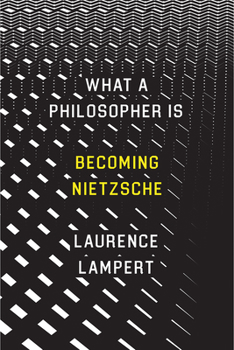
What a Philosopher Is: Becoming Nietzsche
No Customer Reviews

Select Format
Select Condition 
Book Overview
The trajectory of Friedrich Nietzsche's thought has long presented a difficulty for the study of his philosophy. How did the young Nietzsche--classicist and ardent advocate of Wagner's cultural renewal--become the philosopher of Will to Power and the Eternal Return? With this book, Laurence Lampert answers that question. He does so through his trademark technique of close readings of key works in Nietzsche's journey to philosophy: The Birth of Tragedy, Schopenhauer as Educator, Richard Wagner in Bayreuth, Human All Too Human, and "Sanctus Januarius," the final book of the 1882 Gay Science. Relying partly on how Nietzsche himself characterized his books in his many autobiographical guides to the trajectory of his thought, Lampert sets each in the context of Nietzsche's writings as a whole, and looks at how they individually treat the question of what a philosopher is. Indispensable to his conclusions are the workbooks in which Nietzsche first recorded his advances, especially the 1881 workbook which shows him gradually gaining insights into the two foundations of his mature thinking. The result is the most complete picture we've had yet of the philosopher's development, one that gives us a Promethean Nietzsche, gaining knowledge even as he was expanding his thought to create new worlds.
Format:Hardcover
Language:English
ISBN:022648811X
ISBN13:9780226488110
Release Date:January 2018
Publisher:University of Chicago Press
Length:352 Pages
Weight:1.35 lbs.
Dimensions:1.3" x 6.1" x 9.1"
Related Subjects
PhilosophyCustomer Reviews
0 rating
Copyright © 2026 Thriftbooks.com Terms of Use
| Privacy Policy | Do Not
Sell/Share My Personal Information | Cookie Policy | Cookie Preferences | Accessibility Statement
ThriftBooks® and the ThriftBooks® logo are registered trademarks of Thrift Books Global, LLC
ThriftBooks® and the ThriftBooks® logo are registered trademarks of Thrift Books Global, LLC
