


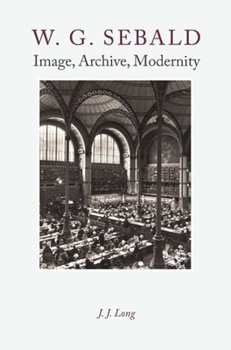
W. G. Sebald: Image, Archive, Modernity

Select Format
Select Condition 
Book Overview
The contemporary German author W. G. Sebald was a master of the fiction of recollection and observation, often exploring the reverberations of World War II on the personal and collective memories of Germans and Jews. His rich body of work earned him legions of fans across the globe, but in the wake of his death in 2001, Sebald also became the subject of extensive critical study. Literary scholars have identified a number of subjects that frequently appear in Sebald's novels: the Holocaust, trauma and memory, melancholy, photography, travel, intertextuality, and the nature and meaning of home, but they have yet to locate an overarching narrative that ties these topics to the broader historical trajectories with which Sebald's work is also fundamentally concerned.
In W. G. Sebald: Image, Archive, Modernity, J. J. Long identifies a wider "meta-problem" in Sebald's work--the problem of modernity. The numerous archival institutions and processes that lie at the heart of modernity are repeatedly explored in Sebald's novels. Photography, museums, libraries, and other institutions for producing and preserving knowledge are among Sebald's main obsessions. Following Foucault, these systems are seen as central to the exercise of power and the constitution of subjectivity, themes embodied in Sebald's melancholy search for autonomous selfhood in an increasingly impersonal and bureaucratized age. Considering the evocation of wonder in the prose narratives of Vertigo, family albums in The Emigrants, the ambulatory narrative in The Rings of Saturn, and the archival subject in Austerlitz, Long advances a highly original interpretation of the author's oeuvre, arguing that Sebald's project needs to be understood as a response not merely to post-Holocaust trauma but to the longer history of modernity.Customer Reviews
ThriftBooks® and the ThriftBooks® logo are registered trademarks of Thrift Books Global, LLC
