


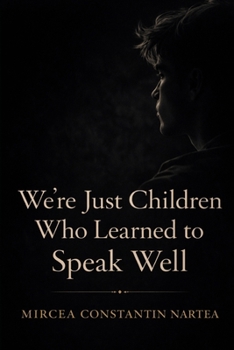
We're Just Children Who Learned to Speak Well

"We're Just Children Who Learned to Speak Well" is a book length essay that explores one unsettling idea with honesty and restraint: that adulthood is often less about wisdom and more about vocabulary. Beneath the confident opinions, the polished arguments, and the performative certainty of modern life, many of us remain emotionally unfinished, carrying the same fears, impulses, and contradictions we had as children, only better articulated.
Written in a reflective and conversational style, this essay moves through themes of identity, insecurity, intelligence, and social performance, questioning how often eloquence is mistaken for depth and confidence for clarity. It examines how people learn to speak fluently long before they learn to understand themselves, and how language becomes both a shield and a disguise in a world that rewards articulation over self awareness.
Part philosophical reflection, part cultural observation, the book does not offer rigid conclusions or structured arguments. Instead, it invites the reader into a slow and intimate line of thought, one that values hesitation, doubt, and emotional truth over neat answers. It speaks to anyone who has ever felt mature on the surface yet uncertain underneath, capable of explaining everything except themselves.
As part of the Essays Without Framework series, this work is intentionally unstructured, allowing ideas to unfold naturally, without chapters designed to instruct or persuade. It is not a guide, a manifesto, or a self help book. It is a quiet examination of how growing up often means learning how to speak convincingly, not necessarily how to live well.
Customer Reviews
ThriftBooks ® and the ThriftBooks ® logo are registered trademarks of Thrift Books Global, LLC
