


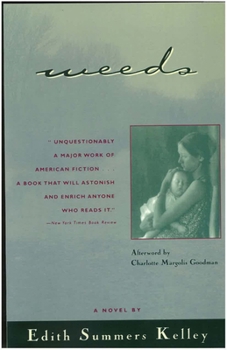
Weeds

Select Format
Select Condition 
Book Overview
Revised
Format:Paperback
Language:English
ISBN:1558611541
ISBN13:9781558611542
Release Date:November 1996
Publisher:Feminist Press at The City University of New York
Length:295 Pages
Weight:1.10 lbs.
Dimensions:1.2" x 5.4" x 8.3"
Customer Reviews
5 ratings
Classic novel on the life of rural Southern women
Published by Thriftbooks.com User , 23 years ago
WEEDS tells the story of poor tenant farmers in rural Kentucky with great power and simplicity. The book's unique greatness comes from it's portayal of this life through the eyes of a spirited and analytic young woman. Set in a ten year period just around World War I, we watch this creative and resilient woman face the overwhelming challenges of rural life. The story is filled with the details of the everyday drudgery and hopelessness of a poor farmer's wife. Though dark, it always has a glimmer of hope and resoluteness that is inspiring. A wonderful novel for women's studies and people interested in rural sociology. Originally written in 1923, Weeds is a classic work that sheds light on both these fields.
Boldly going where few in the early 20th century had gone...
Published by Thriftbooks.com User , 25 years ago
Given what I had heard about this book before I read it I expected a monotonous novel about a mean-spirited woman to leave me prematurely thinking, "What am I gonna read next?" Happily, I found myself the opposite.First of all, I love Ms. Kelley's style of bold writing. She doesn't beat around the bush when it comes to supplying detail. So many writers of the time before it became "hip" to try and shock readers with unspeakable situations were often obscure and obtuse about such things, but details about "the knitting needle," and premarital sex not only surprised me, but allowed me to continue the flow of the story without having to try and decipher what was going on through ten pages of puzzle pieces.And as to the character of Judith, I agree she has some flaws (as is human) but I don't think she is evil. She makes mistakes, but that keeps her interesting. However, she's not without some redemption. For example, when she is contemplating the possible death of her child, she doesn't wish it for hope of a lighter load of work for herself, she wishes only that they escape the life she knows is destined for the child. And in the end she prays for their life. I would call that a mother's love to want true happiness for that child.The conclusion is a rather painful one. It makes sense and follows the timbre of the story, but leaves one with a sadness that things should have turned out better for her. On the outset, it seems to be almost a relief, but there is a great sense of loss which left me with a broken heart. This is definately a great read.
Powerful, beautifully written novel
Published by Thriftbooks.com User , 25 years ago
While there were times when this book was difficult to read, it's unflinching look at rural poverty -- and at life for women before birth control, central heat, running water, electricity, supermarkets, washing machines, etc. -- was powerful and incredibly moving. You don't always like or understand Judith, but you feel deeply for her and her family. If you are interested in learning how people lived -- really lived, day to day -- in early 20th century Appalachia, you must read this book. I loved it.
Beautiful tale
Published by Thriftbooks.com User , 26 years ago
A harsh but realistic look at rural poverty and the bleak life it imposes on those who are born into it, particularly the women. Not for those who romanticize country living and childbirth, but definitely worth reading and one of the most beautifully-written books I've ever encountered. Both depressing and enlightening.
Beautifully and passionately written.
Published by Thriftbooks.com User , 27 years ago
To catagorize this material as 'social realism' as some have done is a mistake. It is a universal story of lost youth and the profound disappointment of unfulfilled potential.
Copyright © 2026 Thriftbooks.com
Terms of Use | Privacy Policy | Do Not Sell/Share My Personal Information | Cookie Policy | Cookie Preferences | Accessibility Statement
ThriftBooks ® and the ThriftBooks ® logo are registered trademarks of Thrift Books Global, LLC
ThriftBooks ® and the ThriftBooks ® logo are registered trademarks of Thrift Books Global, LLC
