
Skip to content
Scan a barcode
Scan
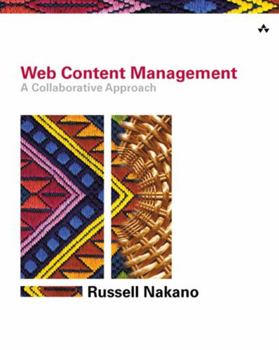
Paperback Web Content Management: A Collaborative Approach Book

ISBN: 0201657821

ISBN13: 9780201657821

Web Content Management: A Collaborative Approach

Today's Web sites require powerful content management solutions that address workflow, usability, deployment, flexibility, scalability, and many other make-or-break issues. This is the first book to cover every aspect of content management for the large-scale or growing site. It offers Web professionals a complete blueprint for developing, deploying, managing, maintaining, and evolving enterprise-class sites with the greatest business value -- at the lowest cost. Nakano first introduces the motivation for content management -- and the problems that rapidly arise when content management solutions are not in place. He introduces key content management concepts and techniques, then presents a complete process and methodology for introducing content management that works. Nakano addresses hot topics such as globalization and workflow, and answers key questions such as: How can I keep my site flexible and dynamic? How can I encourage more employees to contribute content? The book presents real-world Day-in-the-Life case studies from a broad cross-section of companies, large and small, from many industries. For all Web site project managers, architects, administrators, managers, and content specialists working on large sites, or sites expected to grow rapidly.

Recommended

Format: Paperback

Condition: Good

$10.99
Save $34.00!
List Price $44.99
Almost Gone, Only 1 Left!

Customer Reviews

5 ratings

Great for general explanation of web development

Interesting how polarized readers are on this book! I can see that folks needing specific details on web development would not appreciate this book. However, for me, since I wanted a general discussion of how companies develop web sites, it was perfect. My experience in web development for small and medium-size companies tells me that the problems and solutions presented in this book are very real-world. Unlike many books of this type, this book was actually well writen and interesting to read! Nakano makes what could have been very dry discussions more entertaining by including real-life scenarios. The book takes you through web development processes, all the way from the one-man shop to the huge, mega-corporation. Yes, it does not give implementation details, but I think it does a very nice job at explaining the basic models in a black box way. (It is up to you to decide how you are going to do version control or enterprise content management.)

Perfect for the right audience

This book has received both criticisms and accolades, and depending on one's perspective, both are warranted. The best way to determine if this book is for you is to answer the following questions: Are you in a large-scale web environment? Are you using Interwoven? Is content management your job? If you answered yes to two or more questions, then you'll find this book useful.The collaborative approach and the tool features described in this book satisfy the first two questions - the author has obviously chosen to illustrate collaborative content workflows that apply to large-scale sites, and the tool is Interwoven. To readers who work in such an environment and use Interwoven this book is worth its weight in gold. For the reader who has content management responsibilities, the principles and techniques that are presented can be scaled down and put to good use. What I like about the book is that the workflow and techniques, regardless of scale, answer some thorny configuration management and change control issues that are unique to web sites. While the traditional data center world, especially in mainframes, have mature and proven processes, they do not apply to the faster paced requirements of web sites. This is especially the case in web sites because there are competitive pressures, marketing initiatives and other drivers that demand fast changes. Yet, there are opposing forces, such as legal issues, corporate image and systems management processes that counterbalance the drivers. The workflow and techniques for content management that the author proposes shows how to achieve reasonable speed in deploying content, while exercising the necessary due diligence.I obviously like this book, but In can understand the frustration of some readers who had different expectations when they purchased it. I do highly recommend it to anyone who meets the criteria I cited above.

A truly "user friendly" instructional guide

Co-founder of Interwoven, Inc., the market leader in web content infrastructure solutions, Russell Nakano draws upon his many years of expertise and experience to write a truly "user friendly" instructional guide for business managers and web practitioners seeking to create effective (and profitable) websites in Web Content Management: A Collaborative Approach. Aspiring web masters will learn the development principles allowing a website to be effectively entrepreneurial; proven ways to organize an enterprise website; website versioning including concurrent changes and templating; work area/staging area developmental paradigms; distinguishing source files from generated files; work flow and approval patterns for website innovation; handling multiple web initiatives; integrating web systems with databases, template systems, document management systems, deployment and backup systems; and trends in content managements now and in the future. Web Content Management is a strongly recommended title for anyone charged with responsibility for the development and operation of an entrepreneurial website of any kind or category.

Excellent , Detailed Text on Corporate Editorial Workflow

Nakano has delivered clear, useful descriptions explaining the step-by-step "how to," for mapping editorial workflow for web-based publishing. This is critical to the success of the best corporate portals,intranets and .com sites. This approach is also a fundamental requirement for those seeking to get the most out of high-end, enterprise content management solutions their organizations may have purchased (ex:Vignette and Interwoven.) This book will be a strong tool for project managers, corporate subject matter experts, intranet staff and a variety of consultants.

Much needed book on an important subject

This book is an essential resource for anyone who manages web sites of any size or complexity. I purchased this book to research current practices in content management thinking it was applicable only to large sites. I found out that the information was as useful for small sites, including my modest personal site with approximately 20 pages and a few dozen download files.The book starts out with two parts devoted to context and basic mechanics of content management: Part I is a single chapter that discusses motivation for content management, and Part II consists of 7 chapters covering concepts and principles. While Part I is self-evident, Part II is a thorough look at all facets of content management from the definition of an asset through managing multiple web initiatives. Some highlights of Part II include: (1) clear definition of versioning and control mechanisms (in principle they are the same as those used in software configuration management for source code), (2)best practices for collaboration, which includes a well-defined cycle of submit-compare-update-merge and publish process, version snapshots and test cycles, (3)workflow processes that cover people, project, process and business factors, and (4) deploying content, which mirrors to a large degree IT practices for releasing code changes into production. I especially liked the way this aligns to IT operations best practices by treating the process in the same manner as a mature change control process, including roll-back procedures. Also valuable about this Part of the book is the frequent inclusion of checklists.Part III covers design and implementation of content management processes and tools. Here is where workflow, template system and deployment design is elevated from the discussion of concepts and principles in the preceding section into a working system. This part of the book also discusses future trends in content management. Appendices are in Part IV. Each is as valuable as the body of the book, but I particularly liked Appendix B-Workflow Design for Formal Hand Off Between Groups, and Appendix D-Basic Process Steps of a Best-Practice Content Management Process. This book addresses an important subject because managing content on even a small site is no small task. The authors provide a straightforward method, complete with case studies and checklists, to get a handle on what is probably the most difficult aspect of web site management. The writing is clear and the book is exceptionally well illustrated. It is also completely consistent with traditional IT and software engineering practices for change control and software configuration management.
Copyright © 2025 Thriftbooks.com Terms of Use | Privacy Policy | Do Not Sell/Share My Personal Information | Cookie Policy | Cookie Preferences | Accessibility Statement
ThriftBooks ® and the ThriftBooks ® logo are registered trademarks of Thrift Books Global, LLC

GoDaddy Verified and Secured