


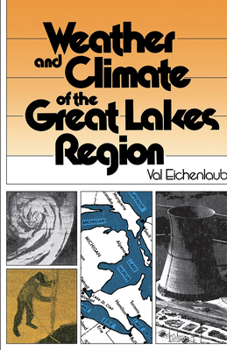
Weather and Climate of the Great Lakes Region


Select Format
Select Condition 
Book Overview
The Great Lakes exert a considerable influence on the weather of the surrounding area, causing fog, clouds, breezes, snowfall, and other "lake effects." This clearly written and profusely illustrated book explains the atmospheric processes underlying the characteristic weather patterns of the region, discusses the climatic history of the Great Lakes, and evaluates the role of air pollution and nuclear power plants.
Weather and Climate of the Great Lakes Region, continues to be a popular textbook for introductory classes in meteorology and climatology.
Format:Hardcover
Language:English
ISBN:0268019290
ISBN13:9780268019297
Release Date:May 1979
Publisher:University of Notre Dame Press
Length:352 Pages
Weight:0.90 lbs.
Dimensions:1.1" x 5.7" x 8.3"
Customer Reviews
2 ratings
Weather and Climate of the Great Lakes Region
Published by Thriftbooks.com User , 19 years ago
This is absolutely the best book on weather that I have ever read. It offers a clear and simple explanation of how and why weather phenomenon occur, not just in the Great Lakes but anywhere. As a pilot and flight instructor I recommend it to all pilots and anyone who just wants to know about weather and why it occurs.
Well-written description of weather around the Lakes
Published by Thriftbooks.com User , 25 years ago
Wow, I was actually surprised to stumble across this title here on this site! I used this volume extensively while completing an undergraduate research project on lake-effect snows downwind of Lake Michigan. As a meteorology major, I skimmed over the introductory chapters regarding general circulation, although, upon re-examination, the author has made the effort to describe larger-scale weather patterns in terms relative to the Great Lakes. My focus on the book was of course, snowfall climatology, so I would like to see an updated climatology incorporating data from the twenty years since the book's original publishing date. Furthermore, there has been more research and newer developments in the science (e.g. NEXRAD (Doppler Radar), El Nino/La Nina effects, global climate change) since 1979 that would add value to a newer edition. Nevertheless, the book discusses effects of the Lakes on more phenomena than just snowfall - fog, clouds, thunderstorms, clear skies, pollution. Descriptions of the mechanisms for Lake-influenced weather have really not changed since the book was published; I would, however, consult a more recent source if you are interested in current climatological numbers. For those that find storms and shipwrecks interesting, there is indeed a chapter regarding significant Great Lakes storms, but it should be noted that this is clearly not the prime focus of the book.If you live near the Great Lakes and wish to know some of the "why" and "how" behind your weather and the Lakes' influences, this book is well-written for a broad spectrum of readers; there is sufficient and clear background information for non-scientists as well as scientific detail for meteorologists.
Copyright © 2026 Thriftbooks.com Terms of Use
| Privacy Policy | Do Not
Sell/Share My Personal Information | Cookie Policy | Cookie Preferences | Accessibility Statement
ThriftBooks® and the ThriftBooks® logo are registered trademarks of Thrift Books Global, LLC
ThriftBooks® and the ThriftBooks® logo are registered trademarks of Thrift Books Global, LLC
